\textbf{Logical Form:} $(\forall x \in \mathbb{Z})(\forall y \in \mathbb{Z}) (6|xy \Rightarrow (2|x \vee 2|y))$
\noindent \textbf{Equivalent Form:} $(\forall x \in \mathbb{Z})(\forall y \in \mathbb{Z})((6|xy \wedge 2 \nmid x) \Rightarrow 2|y)$
\noindent \textit{Assuming more & showing less}
\noindent \textbf{Proof:} Let $x$ and $y$ be arbitrary integers. Suppose that 6 divides $xy$ and that 2 does not divide $x$. Then, there are integers $k$ and $j$ such that $xy = 6k$ and $x = 2j + 1$. Now:
\begin{align*} xy &= 6k \ (2j + 1)y &= 6k \ 2jy + y &= 6k \ y &= 6k - 2jy \ y &= 2(3k - jy) \end{align*}
\noindent As 3, $k$, $j$ and $y$ are integers, and as the integers are closed under multiplication and subtraction, $3k - jy$ is an integer. Thus, 2 divides $y$.
\noindent Hence, if 6 divides $xy$, then either 2 divides $x$ or 2 divides $y$. As $x$ and $y$ were arbitrary, for any integers $x$ and $y$, if 6 divides $xy$, then either 2 divides $x$ or 2 divides $y$.
\noindent \textbf{Proving ($\forall x \in U$) (P(x)) is False by Counter Example:}
\noindent If we are proving a universal statement is false, then we are proving that the negation is true. Recall that: $\neg (\forall x \in U) (P(x))$ is equivalent to: $(\exists x \in U) (\neg P(x))$. This gives us the following outline:
\noindent \textbf{Proof:} Let $x$ = (found in scratch work). Now,… Hence we have $x$ is in U. Now:
\noindent Thus we have that P(x) is false. As $x$ is in U, it is not the case that every $x$ in U makes P(x) true.
\noindent \textbf{Example:} We will prove that $(\forall x \in w) (x^2 + x + 41 \text{ is prime})$ is false by counter example.
\noindent \textbf{Proof:} Let $x = 41$. Notice that $x$ is a whole number. Now:
\noindent $x^2 + x + 41 = 41^2 + 41 + 41 = 41(41 + 1 + 1) = 41(43)$.
\noindent As $x^2 + x + 41 = 41(43)$ and both $41$ and $43$ are integers greater than 1, we have that $x^2 + x + 41$ is a composite number, that is, $x^2 + x + 41$ is not prime.
\noindent As $x$ is a whole number, it is not the case that $x^2 + x + 41$ is prime for all whole numbers.
\noindent \textbf{Note:} In these proofs, the value of $x$ that we find is called a “counter example.”
\textbf{Module 3: Relations, Functions, Injections, Surjections, Bijections}
Let $A$ and $B$ be two sets. The (Cartesian) product $A \times B$ is defined to be: [ A \times B = {(a, b) \mid a \in A \land b \in B} ] “$(a, b)$” is the ordered pair with “a” as the first component and “$b$” as the second.
\textbf{Notation:} We may write $A^2$ to mean $A \times A$ (e.g., $\mathbb{R}^2$, $\mathbb{Z}^2$, etc.)
If $C \subseteq A \times B$, we say that $C$ is a relation from $A$ to $B$ (i.e., if $C$ is a set of ordered pairs whose 1st components come from $A$ and whose 2nd components come from $B$).
If $C \subseteq A^2$, we say that $C$ is a relation on $A$.
``\textbf{Idea:}’’ A relation is a set of ordered pairs.
Let $F \subseteq A \times B$ such that the following two properties hold:
\begin{enumerate} \item[(i)] $(\forall a \in A)(\exists b \in B)((a, b) \in F)$ \item[(ii)] $(\forall a \in A)(\forall b_1 \in B)(\forall b_2 \in B)[((a, b_1) \in F \land (a, b_2) \in F) \Rightarrow b_1 = b_2]$ \end{enumerate}
In this case, we write $F: A \rightarrow B$ and we say ``$F$ is a function from $A$ to $B$’'.
(If (i) doesn’t hold, but (ii) does, we write $F : A \dashrightarrow B$ and say ``$F$ is a partial function from $A$ to $B$.’')
Examples: Let $A = {0, 1, 2, 3, 4}$ and let $B = {0, 2, 4, 6, 8}$
$F_0 = {(0, 8), (1, 6), (2, 4), (3, 2), (4, 0)}$ \hspace{1cm} $F_0 : A \to B$
$F_1 = {(0, 2), (1, 2), (2, 2), (3, 2), (4, 2)}$ \hspace{1cm} $F_1 : A \to B$
$F_2 = {(0, 0), (1, 2), (2, 4), (3, 6), (4, 8), (0, 2)}$ \hspace{0.2cm} $F_2$ is not a function from $A$ to $B$: \begin{enumerate} \item[(ii)] fails: $(0, 0)$ & $(0, 2)$ in $F_2$ but $0 \neq 2$. \end{enumerate}
$F_3 = {(0, 2), (1, 4), (2, 6), (3, 8)}$ \hspace{1cm} $F_3 : A \to B$ \begin{enumerate} \item[(i)] fails as $\forall , y \in A$, but there is not any $b \in B$ such that $(4,b) \in F$. \end{enumerate}
$F_4 = {(0, 0), (2, 1), (4, 2), (6, 3), (8, 4)}$ \hspace{0.2cm} $F_4$ is not a function from $A$ to $B$ as $F \nsubseteq A \times B$
(However: $F_4 : B \to A$)
\vspace{0.5cm}
If $F : A \to B$: \begin{itemize} \item $A = \text{dom}(F)$ \hspace{0.2cm} “The domain of $F$.” \item $B = \text{cod}(F)$ \hspace{0.2cm} “The codomain of $F$.” \item Im$(F) = \text{ran}(F) = {b \in B \mid (\exists a \in A) ((a, b) \in F) }$ \hspace{0.2cm} “The image (or range) of $F$.” \end{itemize}
\vspace{0.5cm}
For $F_0$: dom$(F_0) = A$, cod$(F_0) = B$, ran$(F_0) = B$
For $F_1$: dom$(F_1) = A$, cod$(F_1) = B$, ran$(F_1) = {2}$
\begin{align*} A &= {5, 7, 9, 11} \ B &= {0, 2, 4, 6, 8, 10} \ F &\subseteq A \times B \ F &= {(5,6), (9,10), (11,8), (7,6)} \ G &= {(5,6), (7,10), (9,6), (11,10), (7,4)} \notin A \times B \end{align*}
$G$ is not a function.
S.W.
$x^2 + x + 41 = ( )( )$
$41^2 + 41 + 41 = 41(41+1+1)$
$= (41)(43)$
F \text{ is a function}
Dom(F) = { x \ | \ (\exists y) (x,y) \in F }
And the graph:
The graph shows a curve that is not a function. A horizontal line is drawn intersecting the curve at two points. These points are labeled as $(a, b_1)$ and $(a, b_2)$. The values $b_1$ and $b_2$ are marked on the y-axis, corresponding to the points of intersection. A vertical dashed line is drawn from the top of the curve (i.e. y-axis) at $(a,b_2)$.
\begin{align*} & \text{Dom} (F_0) = A \ & \text{Cod} (F_0) = B \ & \text{Ran} (F_0) = {8, 6, 4, 2, 0 } = B \ & \text{Dom} (F_1) = A \ & \text{Cod} (F_1) = B \ & \text{Ran} (F_1) = {2 } \ & \text{Dom} (F_4) = B \ & \text{Cod} (F_4) = A \ & \text{Ran} (F_4) = A \end{align*}
\begin{align*} &A = {2, 3, 5, 7} \ &B = {\square, \triangle, \circ, \otimes} \ &F: A \rightarrow B \ &F = {(2, \circ), (3, \square), (5, \triangle), (7, \otimes) } \ &Dom(F) = A \ &Cod(F) = B \ &Ran(F) = {\circ, \square, \triangle, \otimes} \ &F: \mathbb{R} \rightarrow \mathbb{R} \ &F(x) = \frac{x^4 + 2}{x^2 + 2x + 100} \end{align*}
\begin{align*} &f: A \rightarrow B\ &\downarrow \text{function}\ &\uparrow \text{Domain} \qquad \uparrow \text{Codomain}\ &f(0) = -1, \quad f(1) = -1, \quad f(2) = 3, \quad f(3) = -5 \end{align*}
\noindent ``Pictures/Visualization’’ of Functions
\bigskip
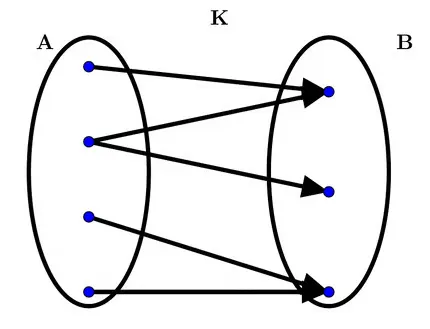
\noindent \begin{tabular}{ccc} A & & A \ F & & G \ B & & B \ \end{tabular}
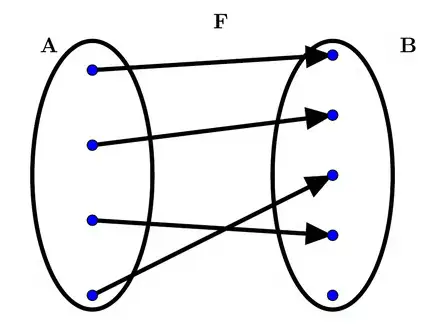
\bigskip \noindent F: is a function, and \ F: $A \rightarrow B$
\bigskip
\noindent \begin{tabular}{ccc} A & & A \ K & & H \ B & & B \ \end{tabular}
\bigskip
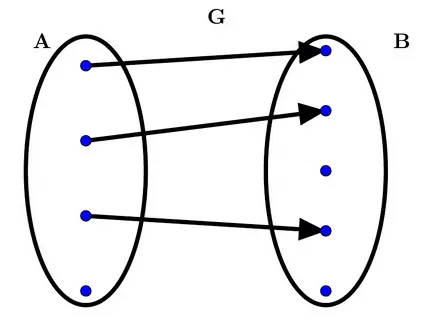
\noindent G is a function, but not a function from A to B as \ (i) fails. (The “top dot” in A doesn’t correspond to a pair in G.) \ We do have G is a \emph{partial} function from A to B: G:$A \dashrightarrow B$
\bigskip
\noindent \begin{tabular}{ccc} & & A \ & J & \ & & B \ \end{tabular}
\bigskip
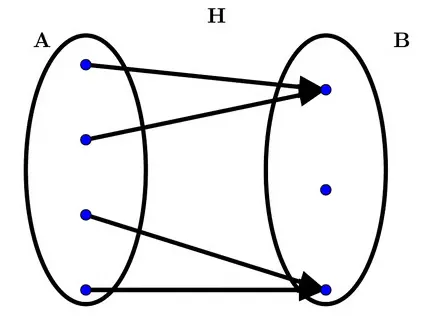
\noindent H: Is a function, and \ H: $A \rightarrow B$
\bigskip \noindent K is not a function as \ (ii) fails as one point in A “goes to” different values in B.
\bigskip
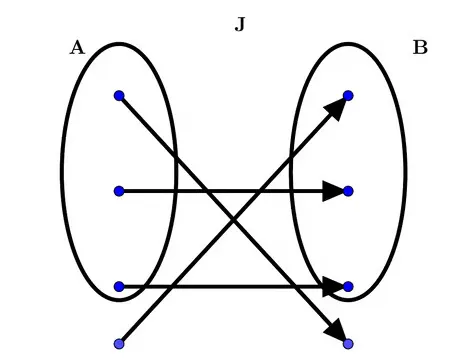
\noindent J is not a function from A to B (as $J \not\subseteq A \times B$), though $J$ is a function by using different sets $\hat{A}$ and $\hat{B}$ for the domain & codomain, say $\hat{A}$ and $\hat{B}$. Then, we could have $J: \hat{A} \rightarrow \hat{B}$.
\bigskip \noindent Comment: I will often refer to property (ii) as the “VLT” (the “Vertical Line Test”).
\bigskip \noindent
\noindent \textbf{“Pictures/Visualization of Functions” NEEDS WORK, 2.12 NOTES PAGE 47} % fix this
% \vspace{0.5cm}
% \begin{tabular}{ll} % \begin{tabular}{c} % A \ % % Insert the image of A here if you can add images % \end{tabular} % & % \begin{tabular}{c} % A \ % % Insert the image of A here if you can add images % \end{tabular} % \ % F & G \ % \begin{tabular}{c} % B \ % % Insert the image of B here if you can add images % \end{tabular} % & % \begin{tabular}{c} % B \ % % Insert the image of B here if you can add images % \end{tabular} % \ % F is a function & G is a partial function: $G: A \to B$ \ % $F: A \to B$ & (i) “fails” (The top dot in A “doesn’t correspond to a pair in G) \ % \end{tabular}
% \vspace{1cm}
% \begin{tabular}{ll} % \begin{tabular}{c} % A \ % % Insert the image of A here if you can add images % \end{tabular} % & % \begin{tabular}{c} % A \ % % Insert the image of A here if you can add images % \end{tabular} % \ % H & J \ % \begin{tabular}{c} % B \ % % Insert the image of B here if you can add images % \end{tabular} % & % \begin{tabular}{c} % B \ % % Insert the image of B here if you can add images % \end{tabular} % \ % \begin{tabular}{c} % K \ % \vspace{0.5cm} % K is not \ % a function % \end{tabular} & % J is not a function from A to B (as $J \nsubseteq A \times B$) \ % & though by using different sets $\hat{A}$ and $\hat{B}$, \ % & we would have $J: \hat{A} \to \hat{B}$ \ % H is not a function: $H: A \to B$ & \ % (ii) fails as different first components go to the same value in B & \ % \end{tabular}
% \vspace{1cm}
\textbf{Comment:} I will often refer to property (ii) as the VLT (the “Vertical Line Test”)
\textbf{Defining Functions:} When we are writing out/defining a function there are three important parts we need to identify: \begin{itemize} \item The Domain \item The Co-domain \item The Ordered Pairs in the function. \end{itemize} If the domain is finite, we can list out all of the ordered pairs in the function, if the domain is large or infinite, we may try to identify a rule to describe which pairs are in the function.
\textbf{Notation:} We may write $f(a) = b$ to mean $(a, b) \in f$. This also gives us: $(a, f(a)) \in f$ for each $a$ in the domain.
\textbf{Example:} $f: \mathbb{N} \to \mathbb{N}$ where $f(n) = 2n - 1$ for each $n \in \mathbb{N}$.
\textbf{Example:} $f: \mathbb{R} \to \mathbb{R}$ where $f(x) = x^2$ for each $x \in \mathbb{R}$.
\textbf{Alternate Rule Notation} “maps to”: $a \mapsto b$ means $(a, b) \in f$, i.e., $f(a) = b$.
\textbf{Example:} $f: \mathbb{N} \to \mathbb{Z}$ where $n \mapsto (-1)^n (2n - 1)$ for each $n \in \mathbb{N}$.
\begin{align*} x+2 &= x-7 \ 2 &\neq 0 \ {a,b,c}\times{1,2,3} &= {(a,1),(a,2),(a,3), (b,1), (b,2), (b,3), (c,1), (c,2), (c,3)} \end{align*}
\section*{Additional Comments} Most of the functions that we will be looking at will be subsets of $\mathbb{R}^2$. If just the “rule” is specified, we assume the domain to be as “large as possible” in $\mathbb{R}$.
\textbf{Example:} Consider $f(x) = \frac{x+2}{x-7}$. We assume that $f: \mathbb{R} \to \mathbb{R}$ (as domain & codomain were not stated).
The only value that can’t be in dom$(f)$ is 7 (can’t divide by zero). So we have:
$f:\mathbb{R} \setminus {7} \to \mathbb{R}$
One reason that we specify the codomain instead of the image/range is that it often is difficult to determine the actual range.
(In the above example, the range is actually $\mathbb{R} \setminus {1}$, but this takes additional work).
Three main rules for domain: \begin{itemize} \item Can’t divide by zero $\frac{A}{0}$ $A \to \neq 0$ \item Can’t take a square root (or other even root) of a negative value $\sqrt[2n]{} \to \geq 0$ \item Can’t take a log of a non-positive value $\ln() \to > 0$ \item $log_b() \to > 0$ \end{itemize}
\textbf{Converse Relations/Functions}
Suppose that $R \subseteq A \times B$. The converse of $R$ is $\hat{R} \subseteq B \times A$ and is defined by:
$$\hat{R} = {(b, a) \in B \times A \mid (a, b) \in R }$$
“Idea”: The converse is just the collection of all “flipped”/reversed ordered pairs.
\textbf{Example:} If $R = {(0, 0), (1, 2), (2, 4), (3, 0)}$, then:
$$\hat{R} = {(0, 0), (2, 1), (4, 2), (0, 3)}.$$
\vspace{0.5cm} Image of R to R^ here %fix this \vspace{0.5cm}
R is a function ($R: {0, 1, 2, 3} \rightarrow {0, 2, 4}$)
\vspace{0.5cm} Image of non-function appear here %fix this \vspace{0.5cm}
$\hat{R}$ is not a function (VLT fails)
We will define a property to determine when the converse of a function is itself a (partial) function.
(\forall a \in Dom)(\forall b \in Dom)(a \neq b \implies R(a) \neq R(b))
\text{Evaluate } f(7).
\begin{aligned} &\text{L.F} \qquad (\forall a \in \mathbb{R}\setminus{7} \ \forall b \in \mathbb{R}\setminus{7} \ (F(a)=F(b) \implies a=b)) \ &\text{Proof: Let } F: \mathbb{R}\setminus{7} \to \mathbb{R} \text{ be the function defined by} \ &F(x) = \frac{x+2}{x-7} \text{ for all } x \text{ in the domain of } F. \ &\text{Let } a \text{ and } b \text{ be arbitrary in } \mathbb{R}\setminus{7} \ &\text{Assume } F(a) = F(b) \ &\quad \quad \quad \vdots (\text{show } a=b) \ &\text{Hence, } a=b. \text{ Thus, if } F(a) = F(b), \text{ then } a=b. \ &\text{As } a \text{ and } b \text{ were arbitrary, } F \text{ is one-to-one.} \end{aligned}
\begin{align*} F(a)&=F(b)\ \frac{a+2}{a-7}&=\frac{b+2}{b-7}\ (a+2)(b-7)&=(b+2)(a-7)\ ab-7a+2b-14&=ab-7b+2a-14\ -7a+2b&=-7b+2a\ -9a&=-9b\ a&=b \end{align*}
In our example, the reason that $R$ wasn’t a (partial) function was that in $R$, two values (0 & 3) both went to 0 (so “flipping” the pairs results in 0 mapping to two different values).
This means that to ensure that the converse of $R: A \to B$ is also a function any different values in the domain must go to different values in the codomain: $$(\forall a \in A) (\forall b \in A) (a \ne b \implies R(a) \ne R(b))$$ By contraposition, this is equivalent to: $$(\forall a \in A) (\forall b \in A) (R(a) = R(b) \implies a = b)$$
\textbf{Definition:} Let $F: A \to B$. We say that $F$ is 1-1 (one-to-one) or an injection, and we write: $F: A \overset{1-1}{\longrightarrow} B$ provided: $$(\forall a \in A) (\forall b \in A) (F(a) = F(b) \implies a = b)$$
\textbf{Outline of a proof that} $F: A \to B$ is an injection:
\textbf{Proof:} Set-up (Introduce / define $F$). Let $a$ and $b$ be arbitrary in $A$. Suppose $F(a) = F(b)$.
Now, …
Hence, $a=b$. Thus, if $F(a) = F(b)$, then $a=b$. As $a$ and $b$ were arbitrary in $A$ (in the domain), $F$ is an injection (one-to-one).
Example: Let $F: \mathbb{R} \setminus {7} \to \mathbb{R}$ be defined by $x \mapsto \frac{x+2}{x-7}$ for all $x \in \mathbb{R} \setminus {7}$. We will prove that $F$ is an injection.
Proof: Let $F: \mathbb{R} \setminus {7} \to \mathbb{R}$ be the function defined by $x \mapsto \frac{x+2}{x-7}$ for all $x \in \mathbb{R} \setminus {7}$. Let $a$ and $b$ be arbitrary in $\mathbb{R} \setminus {7}$. Suppose $F(a) = F(b)$. Now: \begin{align*} \frac{a+2}{a-7} &= \frac{b+2}{b-7} \ (a+2)(b-7) &= (b+2)(a-7) \ ab - 7a + 2b - 14 &= ab - 7b + 2a - 14 \ -7a + 2b &= -7b + 2a \ -9a &= -9b \ a &= b. \end{align*} Hence, $a=b$. Therefore, if $F(a) = F(b)$, then $a=b$. As $a$ and $b$ were arbitrary in the domain of $F$, $F$ is one-to-one.
Example: Let $g : \mathbb{Z} \to \omega$ be defined by $n \mapsto n^2$ for all $n \in \mathbb{Z}$. Prove that $g$ is not one-to-one.
Logical Form: $\neg (\forall a \in \mathbb{Z}) (\forall b \in \mathbb{Z}) (g(a) = g(b) \Rightarrow a=b)$
We prove this using a counter example by the equivalence: $(\exists a \in \mathbb{Z}) (\exists b \in \mathbb{Z}) (g(a) = g(b) \land a \neq b)$.
Scratch Work: We need $g(a) = g(b)$ and $a \neq b$, i.e., we need $a^2 = b^2$ and $a \neq b$.
One case where this will happen is when $a=13$ and $b=-13$.
Proof: Let $g : \mathbb{Z} \to \omega$ be the function defined by $n \mapsto n^2$ for all integers $n$. Let $a = 13$ and let $b = -13$. Note that both $a$ and $b$ are integers. Now:
$g(a) = a^2 = 13^2 = 169 = (-13)^2 = b^2 = g(b)$.
Hence, we have that $g(a) = g(b)$. Also, note that $a = 13 \neq -13 = b$, so $a \neq b$.
Thus, we have that $g(a) = g(b)$ and $a \neq b$. As $a$ and $b$ are integers, there are integers $a$ and $b$ such that $g(a) = g(b)$ and $a \neq b$. Therefore, $g$ is not one-to-one.
\textbf{Example:} Let $g: \mathbb{Z} \rightarrow \omega$ be defined by $n \mapsto n^2$, for all $n \in \mathbb{Z}$. Prove that $g$ is not 1-1.
\textbf{Logical Form:} $\neg \left( \forall a \in \mathbb{Z} \right) \left( \forall b \in \mathbb{Z} \right) \left( g(a) = g(b) \Rightarrow a=b \right)$
We prove this using a counter example by the equivalence: $\left( \exists a \in \mathbb{Z} \right) \left( \exists b \in \mathbb{Z} \right) \left( g(a) = g(b) \land a \neq b \right)$
\textbf{Scratch Work:} We need $g(a) = g(b)$ and $a \neq b$, i.e., we need $a^2 = b^2$ and $a \neq b$. One case where this happens is when $a = 13$ and $b = -13$.
\textbf{Proof:} Let $a = 13$ and let $b = -13$. Note that both $a$ and $b$ are integers. Now:
$g(a) = a^2 = 13^2 = 169 = (-13)^2 = b^2 = g(b)$.
Hence, we have that $g(a) = g(b)$. Also, note that $a = 13 \neq -13 = b$, so $a \neq b$.
Thus, we have that $g(a) = g(b)$ and $a \neq b$. As $a$ and $b$ are integers, there are integers $a$ and $b$ such that $g(a) = g(b)$ and $a \neq b$. Therefore, $g$ is not one-to-one.
Prove: $f: \mathbb{R} \rightarrow \mathbb{R}, \ x \mapsto 7-3x$ for all $x \in \mathbb{R}$ is 1-1.
L.F. $(\forall a \in \mathbb{R})(\forall b \in \mathbb{R})(f(a) = f(b) \Rightarrow a=b)$
Proof: Let $f: \mathbb{R} \rightarrow \mathbb{R}$ be the function defined by $x \mapsto 7-3x$ for all $x \in \mathbb{R}$. Let $a$ and $b$ be arbitrary real numbers.
Suppose $f(a) = f(b)$. Now: \begin{align*} 7 - 3a &= 7 - 3b \ -3a &= -3b \ a &= b. \end{align*}
Hence, $a = b$. Therefore, if $f(a) = f(b)$, then $a = b$.
As $a$ and $b$ were arbitrary, $f$ is an injection.
R = {(1, 3), (4, 7), (9, -10), (7, 3)}
\text{Pass VLT so is function}
\text{Dom}(R) = {1, 4, 9, 7}
\text{Rug}(R) = \text{Im}(R) = {3, 7, -10}
\text{Comments/Definitions in the following proof:} \ \text{i) Provided the VLT property holds for a relation, the relation will be a} \ \text{function for appropriate sets as the domain and codomain.} \ \hookrightarrow \text{This means to show that} \ \hat{F} \ \text{is a function, we only need to}\ \text{show the VLT for} \ \hat{F} \subseteq B \times A \text{:} \ \qquad (\forall b \in B) (\forall a_1 \in A) (\forall a_2 \in A) \left[ (b, a_1) \in \hat{F} \wedge (b, a_2) \in \hat{F}) \Rightarrow a_1 = a_2 \right] \ \text{ii) If X and Y are sets, we say } X = Y \text{ exactly when:} \ \qquad (X \subseteq Y \wedge Y \subseteq X) \ \text{iii) If X and Y are sets we have } X \subseteq Y \text{ exactly when:} \ \qquad (\forall x) (x \in X \Rightarrow x \in Y) \ \text{iv) The domain of a Function/Relation } R \subseteq A \times B \text{ can be defined} \ \text{by:} \ \qquad dom(R) = { a \in A \ | \ (\exists b \in B) ((a, b) \in R) }
\begin{align*} R &= {1,2,3,4} \times {6,8,10} \ R &= {(1,6), (1,8), (3,10)} \quad \text{(Not fn.)} \ \text{Dom}(R) &= {1,3} \ \text{Im}(R) &= {6,8,10} \end{align*}
We Introduced the Theorem on the next page, but have not yet gone through the proof (pg 55-56). The entire proof is scanned here so that it is complete in this file/not cut off.
$(\Rightarrow)$ Suppose that $\hat{F}$ is a function. Let $a$ and $b$ be arbitrary in the domain of $F$ and suppose $F(a) = F(b)$. Denote the value of $F(a) = F(b)$ by $c$ (i.e., $F(a) = c$ and $F(b) = c$). Now, we have that both $(a, c) \in F$ and $(b, c) \in F$. By the definition of the converse, we have that $(c, a) \in \hat{F}$ and $(c, b) \in \hat{F}$. As $\hat{F}$ is a function, we have that $a = b$. Thus, if $F(a) = F(b)$, then $a = b$. As $a$ and $b$ were arbitrary, $F$ is one-to-one. Thus, if $\hat{F}$ is a function, then $F$ is one-to-one.
$(\Leftarrow)$ Now, suppose $F$ is one-to-one. Let $b \in B$ be arbitrary and let $a_1$ and $a_2$ be arbitrary in $A$. Suppose that $(b, a_1) \in \hat{F}$ and that $(b, a_2) \in \hat{F}$. By the definition of the converse, we have $(a_1, b) \in F$ and $(a_2, b) \in F$, i.e., that $F(a_1) = b$ and $F(a_2) = b$. Hence, $F(a_1) = F(a_2)$. As $F$ is one-to-one, we have that $a_1 = a_2$. Therefore, if $(b, a_1) \in \hat{F}$ and $(b, a_2) \in \hat{F}$, then $a_1 = a_2$. As $b, a_1$, and $a_2$ were arbitrary, $\hat{F}$ is a function. Thus, if $F$ is one-to-one, then $\hat{F}$ is a function.
We’ve shown both directions of the biconditional. Hence, $\hat{F}$ is a function iff $F$ is one-to-one.
($dom(\hat{F}) = ran(F)$): Let $x \in dom(\hat{F})$ be arbitrary. Then, there is some $y \in A$ such that $(x,y) \in \hat{F}$. By the definition of the converse, $(y,x) \in F$. As $y \in A$ and $(y,x) \in F$, we have that $x \in Ran(F)$. As $x$ was arbitrary, $dom(\hat{F}) \subseteq Ran(F)$.
Now, let $x \in Ran(F)$ be arbitrary. Then, there is some $y \in A$ such that $(y,x) \in F$. By the definition of the converse, $(x,y) \in \hat{F}$. Hence, $x \in dom(\hat{F})$. As $x$ was arbitrary, $Ran(F) \subseteq dom(\hat{F})$.
Thus, we have $dom(\hat{F}) = Ran(F)$.
($ran(\hat{F}) = dom(F)$): Let $x \in ran(\hat{F})$ be arbitrary. Then, there is some $y \in B$ such that $(y,x) \in \hat{F}$. This implies that $(x,y) \in F$. Hence, $x \in dom(F)$. As $x$ was arbitrary, $ran(\hat{F}) \subseteq dom(F)$.
Now, let $x \in dom(F)$ be arbitrary. Then, there is some $y \in B$ such that $(x,y) \in F$. This implies that $(y,x) \in \hat{F}$. As $y \in B$, we have that $x \in ran(\hat{F})$. As $x$ was arbitrary, $dom(F) \subseteq ran(\hat{F})$.
Thus, we have $ran(\hat{F}) = dom(F)$.
Comments/Definitions in the following proof:
i) Provided the VLT property holds for a relation, the relation will be a function for appropriate sets as the domain and codomain.
$\hookrightarrow$ This means to show that $\hat{F}$ is a function, we only need to show the VLT for $\hat{F} \subseteq B \times A$:
$(\forall b \in B) (\forall a_1 \in A) (\forall a_2 \in A) [((b, a_1) \in \hat{F} \land (b, a_2) \in \hat{F}) \Rightarrow a_1 = a_2]$
ii) If $X$ and $Y$ are sets, we say $X = Y$ exactly when:
$(X \subseteq Y \land Y \subseteq X)$
iii) If $X$ and $Y$ are sets we have $X \subseteq Y$ exactly when:
$(\forall x)(x \in X \Rightarrow x \in Y)$
iv) The domain of a Function/Relation $R \subseteq A \times B$ can be defined by:
$\text{dom}(R) = {a \in A \mid (\exists b \in B)((a,b) \in R)}$
\begin{aligned} & F: A \to B \text{ is 1-1} \ & \text{iff} \ & \qquad (\forall a \in A) (\forall b \in A) (F(a) = F(b) \implies a = b) \ & G: A \to B \ & \text{VLT:} \quad (\forall a \in A) (\forall b_1 \in B) (\forall b_2 \in B) \left( \begin{aligned} & [(a, b_1) \in G \ & \wedge (a, b_2) \in G] \ & \implies b_1 = b_2 \end{aligned} \right) \ & F: A \to B \ & F: B \to A \end{aligned}
\begin{align*} &F = {(0,1), (1,1), (2, 1)} \quad F: {0,1,2,3} \rightarrow {1} \ &F = {(1,0), (1,1), (1,2)} \end{align*}
\geometry{a4paper, margin=1in}
\textbf{Theorem:} Let $F: A \to B$, and let $\hat{F} \subseteq B \times A$ be the converse of $F$. Then $$ \hat{F} \text{ is a function } \iff F \text{ is an injection}. $$ Furthermore, $\text{dom}(\hat{F}) = \text{ran}(F)$ and $\text{ran}(\hat{F}) = \text{dom}(F)$.
\textbf{Proof:} Let $F: A \to B$ and let $\hat{F} \subseteq B \times A$ be the converse of $F$.
($\implies$) Suppose that $\hat{F}$ is a function. Let $a$ and $b$ be arbitrary in the domain of $F$ and suppose $F(a) = F(b)$. Denote the value of $F(a) = F(b)$ by $c$ (i.e., $F(a) = c$ and $F(b) = c$). Now, we have that both $(a,c) \in F$ and $(b,c) \in F$. By the definition of the converse, we have that $(c,a) \in \hat{F}$ and $(c,b) \in \hat{F}$. As $\hat{F}$ is a function, we have that $a = b$. Thus, if $F(a) = F(b)$, then $a = b$. As $a$ and $b$ were arbitrary, $F$ is one-to-one. Thus, if $\hat{F}$ is a function, then $F$ is one-to-one.
($\impliedby$) Now, suppose $F$ is one-to-one. Let $b \in B$ be arbitrary and let $a_1$ and $a_2$ be arbitrary in $A$. Suppose that $(b, a_1) \in \hat{F}$ and that $(b, a_2) \in \hat{F}$. By the definition of the converse, we have $(a_1, b) \in F$ and $(a_2, b) \in F$, i.e., that $F(a_1) = b$ and $F(a_2) = b$. Hence, $F(a_1) = F(a_2)$. As $F$ is one-to-one, we have that $a_1 = a_2$. Therefore, if $(b, a_1) \in \hat{F}$ and $(b, a_2) \in \hat{F}$, then $a_1 = a_2$. As $b, a_1$, and $a_2$ were arbitrary, $\hat{F}$ is a function. Thus, if $F$ is one-to-one, then $\hat{F}$ is a function.
We’ve shown both directions of the biconditional. Hence, $\hat{F}$ is a function iff $F$ is one-to-one.
(dom ($\hat{F}$) = ran($F$)): Let $x \in \text{dom}(\hat{F})$ be arbitrary. Then, there is some $y \in A$ such that $(x,y) \in \hat{F}$. By the definition of the converse, $(y,x) \in F$. As $y \in A$ and $(y,x) \in F$, we have that $x \in \text{Ran}(F)$. As $x$ was arbitrary, $\text{dom}(\hat{F}) \subseteq \text{Ran}(F)$.
Now, let $x \in \text{Ran}(F)$ be arbitrary. Then, there is some $y \in A$ such that $(y,x) \in F$. By the definition of the converse, $(x,y) \in \hat{F}$. Hence, $x \in \text{dom}(\hat{F})$. As $x$ was arbitrary, $\text{Ran}(F) \subseteq \text{dom}(\hat{F})$.
Thus, we have $\text{dom}(\hat{F}) = \text{Ran}(F)$.
(ran($\hat{F}$) = dom($F$)): Let $x \in \text{ran}(\hat{F})$ be arbitrary. Then, there is some $y \in B$ such that $(y,x) \in \hat{F}$. This implies that $(x,y) \in F$. Hence, $x \in \text{dom}(F)$. As $x$ was arbitrary, $\text{ran}(\hat{F}) \subseteq \text{dom}(F)$.
Now, let $x \in \text{dom}(F)$ be arbitrary. Then, there is some $y \in B$ such that $(x,y) \in F$. This implies that $(y,x) \in \hat{F}$. As $y \in B$, we have that $x \in \text{ran}(\hat{F})$. As $x$ was arbitrary, $\text{dom}(F) \subseteq \text{ran}(\hat{F})$.
Thus, we have $\text{ran}(\hat{F}) = \text{dom}(F)$.
\text{Need } x,y \in \text{Dom s.t} \qquad x \neq y \text{ and } f(x) = f(y)
\begin{align*} ad - bc &= 0 \Rightarrow \ x - y &= 0 \end{align*}
\begin{align*} \frac{ax + b}{cx + d} &= \frac{ay + b}{cy + d} \ (ax + b)(cy + d) &= (ay + b)(cx + d) \ acxy + adx + bcy + bd &= acxy + bcx + ady + bd \ adx - bcx &= ady - bcy \ (ad - bc)x &= (ad - bc)y \ (ad - bc)x - (ad - bc)y &= 0 \ (ad - bc)(x - y) &= 0 \end{align*}
\textbf{Theorem:} Let $a, b, c,$ and $d$ be real numbers with $c$ and $d$ not both equal to zero.
Let $f : \mathbb{R} \setminus {-\frac{d}{c}} \to \mathbb{R}$ be the function defined by $x \mapsto \frac{ax+b}{cx+d}$ for all $x \in \text{dom}(f)$.
Then, $f$ is $1-1$ iff $ad - bc \neq 0$.
For the proof of this theorem, we will use the “Zero Product Property” of the real numbers: $$(\forall \hat{a} \in \mathbb{R}) (\forall \hat{b} \in \mathbb{R}) (\hat{a}\hat{b} = 0 \implies (\hat{a} = 0 \vee \hat{b} = 0))$$
\textbf{Logical Form:} $(f \text{ is } 1-1) \iff (ad - bc \neq 0)$
(Comment: The above form has the quantification of $a, b, c, d$ (and $f$) suppressed. For $a, b, c, d$ (and $f$) the universal quantifier would be used.)
\textbf{Equivalent Forms:} \begin{align*} \left(\left(\forall x \in \text{dom}(f)\right) \left(\forall y \in \text{dom}(f) \right) (f(x) = f(y) \implies x = y)\right) \iff (ad - bc \neq 0) \quad \text{(Def }1-1) \ \left[(f \text{ is } 1-1) \implies (ad - bc \neq 0)\right] \land \left[(ad - bc \neq 0) \implies (f \text{ is } 1-1)\right] \quad \left( \substack{\text{“Two Part”}\ \text{proof of } \iff } \right) \ \left[(ad - bc = 0) \implies \neg (f \text{ is } 1-1)\right] \land \left[(ad - bc \neq 0) \implies (f \text{ is } 1-1)\right] \quad \text{(Contrapositive)} \ \left[(ad - bc = 0) \implies \left( \exists x \in \text{dom}(f) \right) \left( \exists y \in \text{dom}(f) \right) (f(x) = f(y) \land x \neq y)\right] \ \land \left[(ad - bc \neq 0) \implies \left( \forall x \in \text{dom}(f) \right) \left( \forall y \in \text{dom}(f) \right) (f(x) = f(y) \implies x = y)\right] \quad \text{(Def }1-1 \text{ and negation of } 1-1) \end{align*}
“Full” / Quantified Logical Form:
[ (\forall a \in \mathbb{R}) (\forall b \in \mathbb{R}) (\forall c \in \mathbb{R}) (\forall d \in \mathbb{R}) \left( \left( f(x) = \frac{ax+b}{cx+d} \right) \implies \left( \underbrace{c^2 + d^2 \neq 0}{\substack{c \text{ & } d \text{ not} \ \text{both zero}}} \implies \left( \forall f \in \mathbb{R} \setminus {-\frac{d}{c} } , f : \mathbb{R} \setminus {-\frac{d}{c} } \to \mathbb{R} \right) \left( \forall x \in \mathbb{R} \setminus {-\frac{d}{c} } \right) (f(x) = f(y) \implies x = \hat{y}) \right) \iff (ad-bc \neq 0) \right) ]
[
\begin{aligned}
&(\forall a, b, c, d \in \mathbb{R}) \Bigg[
\left( f(x) = \frac{ax + b}{cx + d} \right)
\implies
\Bigg(
\underbrace{c^2 + d^2 \neq 0}{\substack{c \text{ and } d \ \text{not both zero}}}
\implies \
&\quad\left(
\forall f : \mathbb{R} \setminus \left{ -\frac{d}{c} \right} \to \mathbb{R},\
\forall x, y \in \mathbb{R} \setminus \left{ -\frac{d}{c} \right},
f(x) = f(y) \Rightarrow x = y
\right)
\Bigg)
\iff (ad - bc \neq 0)
\Bigg]
\end{aligned}
]
Additional Comment: In the case where $c=0$ (and $d \neq 0$), we have that $f : \mathbb{R} \to \mathbb{R}$ (as $-\frac{d}{c}$ is not defined / not a real number so that $\mathbb{R} \setminus { -\frac{d}{c} } = \mathbb{R}$).
The set-up of our proof will still follow this quantified form with one minor adjustment:
We won’t use the key-word “arbitrary” when introducing the function $f$. This is due to the fact that we are defining a specific function. (We could still use the word “arbitrary” in the proof here, it just isn’t needed.)
\begin{enumerate} \item Proof: Let a,b,c and d be arbitrary real numbers with c and d not both equal to zero. Then,
let $f: \mathbb{R} \backslash \{-d/c \} \to \mathbb{R}$ be the function defined by
$x \mapsto
\begin{cases}
\frac{ax+b}{cx+d} \text{ for all x in the domain of f. if c≠0,}\\
x+1 \text{ if c=0.}
\end{cases}
$
$\implies$ Now, suppose ad-bc = 0. let $x = \{ -\frac{d}{c} +1 \text{ if c≠0,} \} $
1,C and d are real and as the reals are closed under addition,
subtraction and division by non-zero values, we have that$-\frac{d}{c} +1$ is
real, so that x is real. We will show that $x \neq -\frac{d}{c}$. Towards a
contradiction, suppose $x = -\frac{d}{c}$. Then, as $x = -\frac{d}{c} +1$, we have that
$-\frac{d}{c} = -\frac{d}{c} +1$, so that 0=1. As O≠1, we have a contradiction.
Hence, X * -d/c. Therefore, $X \in \mathbb{R} \backslash \{-d/c \}$, i.e., x is in the domain of f.
If c = 0, then we have x=1, so that x is real. When C=0,
$\mathbb{R} \backslash \{-\frac{d}{c}\} = \mathbb{R} $, so that x is in the domain of f. Now, let y = x+1.
As x is real and 1 is real and the reals are closed under addition,
X+l is real, so that y is real. If c≠0, we have that $y = -\frac{d}{c}+2$.
As was the case with x, we have that $y \neq -\frac{d}{c}$, so that y is in the
domain of f. If C=0, we have that the domain of f is $\mathbb{R} $ and y is thus in
the domain. Next, we show that x≠y. If c≠0, we have $x=-\frac{d}{c}+1$
and x = $-\frac{d}{c}+2$. Note that $1\neq2 $, so that $-\frac{d}{c}+1\neq -\frac{d}{c}+2$, and x≠Y.
\end{enumerate}
We now will show that we do have that $f(x)=f(y)$. Note that: \begin{align*} 0 &= 0 \ 0(x-y) &= 0 \ (ad-bc)(x-y) &= 0 \ (ad-bc)x - (ad-bc)y &= 0 \ (ad-bc)x &= (ad-bc)y \ adx - bcx &= ady - bcy \ adx + bcy &= ady + bcx \ acxy + adx + bcy + bd &= acxy + ady + bcx + bd \ a(cy+d) + b(cy+d) &= a(cx+d) + b(cx+d) \ (cy+d)(ax+b) &= (cx+d)(ay+b) \ \frac{ax+b}{cx+d} &= \frac{ay+b}{cy+d} \ f(x) &= f(y). \end{align*} Thus, we have $f(x) = f(y)$. As $x \neq y$ and $f(x) = f(y)$, and $x$ and $y$ are in the domain of $f$, we have that $f$ is not one-to-one. Thus, if $ad-bc = 0$ then $f$ is not one-to-one. Hence, by contraposition, if $f$ is one-to-one, then $ad-bc \neq 0$.
$(\Leftarrow)$ Now, suppose $ad-bc \neq 0$. Let $x$ and $y$ be arbitrary in the domain of $f$.
Suppose $f(x)=f(y)$. Now:
$\frac{ax+b}{cx+d} = \frac{ay+b}{cy+d}$
$(ax+b)(cy+d) = (ay+b)(cx+d)$
$acxy + adx +bcy +bd = acxy + ady+bcx + bd$
$adx +bcy - ady - bcx = 0$
$adx-bcx + bcy-ady = 0$
$(ad-bc)x - (ad-bc)y = 0$
$(ad-bc)(x-y) = 0$.
By the zero product property, we must either have that $ad-bc=0$ or that $x-y=0$. As $ad-bc\neq0$, this implies that $x-y=0$, so that $x=y$. Thus, if $f(x) = f(y)$, then $x=y$. As $x$ and $y$ were arbitrary, for all $x$ and $y$ in the domain of $f$, if $f(x) = f(y)$, then $x=y$. Hence, $f$ is one-to-one. Thus, if $ad-bc \neq 0$, then $f$ is one-to-one.
We have shown both directions of the biconditional, hence $f$ is 1-1 iff $ad-bc\neq0$. As $a, b, c,$ and $d$ were arbitrary, for any real numbers $a, b, c$ and $d$ with $c$ and $d$ not both equal to zero, for $f : \mathbb{R}\setminus{-\frac{d}{c}} \rightarrow \mathbb{R}$, defined.
by $x \mapsto \frac{ax+b}{cx+d}$ for every x in the domain, we have that f is an injection iff ad-bc $\neq$ 0.
\begin{aligned} & 3 \cdot 4 \mod 6 = 0 \ & (A \implies B) \ &= \neg B \implies \neg A \end{aligned}
\begin{align*} f: \mathbb{R} &\to [0, \infty), \quad x \mapsto x^2 \ \text{Dom}(f) &= \mathbb{R} \ \text{Cod}(f) &= [0, \infty) \ \text{Range}(f) &= \text{Im}(f) = [0, \infty) \end{align*}
(A \subseteq B) \ (\exists a \in A) \ (Fa = b)
Consider the function $f : \mathbb{R} \to \mathbb{R}$ defined by $x \mapsto x^2$ for all $x \in \mathbb{R}$.
\begin{align*} \text{Dom}(f) &= \mathbb{R} \ \text{Cod}(f) &= \mathbb{R} \ \text{Im}(f) &= [0, \infty) \quad \text{(Range)} \end{align*}
Visually, this is because $f$ fails the “Horizontal Line Test” (HLT).
If we “changed” the codomain and considered $\hat{f} : \mathbb{R} \to [0, \infty)$ defined by $x \mapsto x^2$ for all $x \in \mathbb{R}$, then we would have that the codomain and the image/range would be equal / the same.
If a function is such that the codomain and image are equal (the same), i.e., if $\text{Cod}(f) = \text{Im}(f)$, we say that the function is onto or is a surjection.
In this case, we may write: $f : A \xrightarrow{\text{onto}} B$.
\section*{Surjections / Onto Functions}
A function $f: A \to B$ is \textbf{onto} / a \textbf{surjection} when $\text{Cod}(f) = B = \text{Im}(f)$.
This “means” that everything in $B$ needs to be mapped to by at least one value in $A$ (the domain).
\bigskip
\noindent
\bigskip
\noindent $f: A \to B$ is $\underline{\text{not onto}}$, $\underline{\text{not 1-1}}$.
\bigskip
\noindent
\bigskip
\noindent $g: A \to B$ is $\underline{\text{not onto}}$, $\underline{\text{is 1-1}}$.
\bigskip
\noindent
\bigskip
\noindent $h: A \to B$ is $\underline{\text{is onto}}$, $\underline{\text{not 1-1}}$.
\bigskip
\noindent
\bigskip
\noindent $k: A \to B$ is $\underline{\text{is onto}}$, $\underline{\text{is 1-1}}$.
\bigskip
\noindent \textit{Notice that being 1-1 & onto are unrelated (one doesn’t imply / give the other).}
f: A \rightarrow B \text{ is 1-1 iff } (\forall a \in A)(\forall b \in A)(F(a) = f(b) \Rightarrow a = b)
\text{The Logical Form of the Definition of Cuto} \
\text{A function } f: A \rightarrow B \text{ is onto/a surjection iff:} \
(\forall b \in B)(\exists a \in A)(f(a) = b) \
\text{For every value }b \text{ in } Cod(f)=B, \text{ we can find a value } a \text{ in } Dom(f) = A,\\ \text{such that } f \text{ maps/takes } a \text{ to } b.\text{''} \\ \text{Outline’’} \text{ of a proof that } f: A \rightarrow B \text{ is a surjection: }\
\text{Proof:} (\text{Introduce the function}) \
\text{Let } b \text{ be arbitrary in } B.\
\text{Let } a = (\text{value found in scratch work}). \
(\text{Show } a \in A)^* \
\text{Now: } f(a) = … = b (\text{``calculation’’})\
^{*} \text{In many cases this is done by closure} \
\text{\quad contradiction & properties.}\
\text{Thus,} f(a) = b. \text{As } a \in A, \text{ there exists an } a \text{ in } A \text{ such that } f(a)=b.\
\text{As } b \text{ was arbitrary, for all } b \text{ in } B, \text{ there is an } a \text{ in } A \text{ such that } \
f(a) = b. \text{Thus, } f \text{ is a surjection/is onto.}
\begin{align*} F: A \rightarrow B \text{ is 1-1 iff } (\forall a \in A) (\forall b \in A) (f(a) = f(b) \Rightarrow a = b) \text{ (Injection)} \ F: A \rightarrow B \text{ is onto iff } (\forall b \in B) (\exists a \in A) (f(a) = b) \text{ (Surjection)} \ \text{iff} \quad \text{Cod}(f) = \text{Range}(F) \end{align*}
Onto: $(\forall b \in B)(\exists a \in A)(f(a) = b)$
want $f(a) = b$
$a - 7 = b$
$a = b + 7$
The Logical Form of the Definition of Onto \ A function $f: A \rightarrow B$ is onto/a surjection iff: [ (\forall b \in B)(\exists a \in A)(f(a) = b) ] “For every value $b$ in $Cod(f) = B$, we can find a value $a$ in $Dom(f) = A$, such that $f$ maps/takes $a$ to $b$.”
``Outline’’ of a proof that $F: A \rightarrow B$ is a surjection:
\textbf{Proof:} (Introduce the function) \ Let $b$ be arbitrary in $B$. \ Let $a = \text{(value found in scratch work)}$. \ (Show $a \in A$)* \begin{itemize} \item In many cases this is done by contradiction & closure properties. \end{itemize} Now: $f(a) = \dots = b$. (``calculation’’) \ Thus, $f(a) = b$. As $a \in A$, there exists an $a$ in $A$ such that $f(a) = b$. \ As $b$ was arbitrary, for all $b$ in $B$, there is an $a$ in $A$ such that $f(a) = b$. Thus, $f$ is a surjection/is onto.
\textbf{Example:} We will prove that $f: \mathbb{R} \to \mathbb{R}$, defined by $f(x) = 2x - 7$ is onto.
\textbf{Logical Form:} $(\forall b \in \mathbb{R}) (\exists a \in \mathbb{R}) (f(a) = b)$
\textbf{Scratch Work:} We need $f(a) = b: \quad 2a - 7 = b \implies 2a = b + 7 \implies a = \frac{b+7}{2}$.
\textbf{Proof:} Let $f: \mathbb{R} \to \mathbb{R}$ be the function defined by $x \mapsto 2x - 7$ for all $x \in \mathbb{R}$.
Let $b$ be an arbitrary real number. Let $a = \frac{b+7}{2}$. Notice that $2$, $7$, and $b$ are real numbers, so that as the reals are closed under addition and division by non-zero values, $\frac{b+7}{2}$ is real. Hence, we have that $a$ is real, i.e., that $a$ is in the domain of $f$.
Now: $$f(a) = 2a - 7 = 2\left(\frac{b+7}{2}\right) - 7 = (b+7) - 7 = b.$$
Hence, we have that $f(a) = b$. As $a$ is real, there is a real number $a$ such that $f(a) = b$. As $b$ was arbitrary, for all real numbers $b$, there exists a real number $a$ such that $f(a) = b$. Hence, $f$ is a surjection.
Example: We will prove that $f: \mathbb{R} \setminus {7} \to \mathbb{R} \setminus {5}$ defined by $x \mapsto \frac{5x-2}{x-7}$ is onto.
Logical Form: $\left(\forall b \in \mathbb{R} \setminus {5}\right) \left( \exists a \in \mathbb{R} \setminus {7} \right) \left( f(a) = b \right)$
Scratch Work: Need to find $a \in \mathbb{R} \setminus {7}$ such that $f(a) = b$: $\frac{5a-2}{a-7} = b$
$\Rightarrow (5a-2) = b(a-7) \Rightarrow 5a-2 = ab - 7b \Rightarrow 5a - ab = 2 - 7b$
$\Rightarrow a(5-b) = 2-7b \Rightarrow a = \frac{2-7b}{5-b}$.
Closure properties of $\mathbb{R}$ (and that $b \neq 5$) will give us $a \in \mathbb{R}$.
We will use a contradiction to show $a \neq 7$. (Assume $a = 7$ and get a false statement).
Proof: Let $f: \mathbb{R} \setminus {7} \to \mathbb{R} \setminus {5}$ be the function defined by $f(x) = \frac{5x-2}{x-7}$ for all $x$ in $\mathbb{R} \setminus {7}$. Let $b$ be in $\mathbb{R} \setminus {5}$ be arbitrary. Let $a = \frac{2-7b}{5-b}$. Note that $b \neq 5$, so that $5-b \neq 0$. As, 2, 5, 7 and $b$ are real, and as $5-b \neq 0$, we have that as the reals are closed under subtraction, multiplication and division by non-zero values, $\frac{2-7b}{5-b}$ is real, i.e., $a$ is real.
We claim that $a \neq 7$. Towards a contradiction, suppose $a=7$. Now:
$$ a = \frac{2-7b}{5-b}$$ $$ 7 = \frac{2-7b}{5-b}$$
\begin{align*} 7(5-b) &= 2 - 7b \ 35 - 7b &= 2 - 7b \ 35 &= 2. \end{align*}
Now, we have that $35 = 2$. As $35 \neq 2$, we have a contradiction, hence $a \neq 7$, as claimed. Thus, $a \in \mathbb{R} \setminus {7}$, that is a is in the domain of $f$.
Now, notice: \begin{align*} f(a) &= \frac{5a - 2}{a - 7} \ &= \frac{5(\frac{2-7b}{5-b}) - 2}{(\frac{2-7b}{5-b}) - 7} \ &= \frac{5(2-7b) - 2(5-b)}{(2-7b) - 7(5-b)} \ &= \frac{10 - 35b - 10 + 2b}{2 - 7b - 35 + 7b} \ &= \frac{-33b}{-33} \ &= b. \end{align*}
Hence, $f(a) = b$. As $a \in Dom(f)$, then is an $a \in Dom(f)$ such that $f(a) = b$. As $b \in Cod(f)$ was arbitrary, for all $b \in Cod(f)$, there is an $a \in Dom(f)$ such that $f(a) = b$. Hence, $f$ is onto.
Example: We will prove that $f: \mathbb{R}\setminus{\frac{9}{8}} \rightarrow \mathbb{R}$ defined by $x \mapsto \frac{2x+1}{8x-9}$ is not a surjection.
Logical Form: $\neg (\forall b \in \mathbb{R})(\exists a \in \mathbb{R}\setminus {\frac{9}{8}}) (f(a)=b)$
Equivalent Form (simplified): $(\exists b \in \mathbb{R}) (\forall a \in \mathbb{R}\setminus{\frac{9}{8}}) (f(a) \neq b)$
We need to find a real number $b$ that nothing in the domain maps to.
We will examine $f(a) = \frac{2a+1}{8a-9}$
\begin{array}{r} \frac{1}{4} \ 8a-9 \overline{) 2a+1} \ \underline{-(2a - \frac{9}{4})} \ \frac{13}{4} \end{array}
Now: $f(a) = \frac{2a+1}{8a-9} = \frac{1}{4} + \frac{\frac{13}{4}}{8a-9}$
This means that $f(a)$ can’t equal $\frac{1}{4}$ (this is the value of $b$ we were looking for)
(Never equals zero ($\frac{A}{B} = 0$ iff $A=0$ & $B\neq0$))
Comment: We could also look at the graph, which has a horizontal asymptote at $y = \frac{1}{4}$, which the curve doesn’t cross.
Proof: Let $f: \mathbb{R} \setminus {\frac{9}{8}} \to \mathbb{R}$ be the function defined by $f(x) = \frac{2x+1}{8x-9}$ for all $x \in \mathbb{R} \setminus {\frac{9}{8}}$. Let $b = \frac{1}{4}$. Note that $b \in \mathbb{R}$, so that $b$ is in the codomain of $f$. Now, let $a \in \mathbb{R} \setminus {\frac{9}{8}}$ be arbitrary. We will show that $f(a) \ne b$. Towards a contradiction, suppose $f(a) = b$. Now: $$ \frac{2a+1}{8a-9} = \frac{1}{4} $$ $$ 4(2a+1) = 8a-9 $$ $$ 8a + 4 = 8a - 9 $$ $$ 4 = -9 $$ Now, we have $4 = -9$. As $4 \ne -9$, we have a contradiction. Hence, $f(a) \ne b$. As $a$ was arbitrary, for every $a$ in the domain, $f(a) \ne b$. As $b$ is in the codomain, there is a $b$ in the codomain, such that for all $a$ in the domain, $f(a) \ne b$. Hence, $f$ is not a surjection.
f: A \rightarrow B
\begin{align*} 1 &\mapsto (1,1) \mapsto 1 \ 2 &\mapsto (1,2) \mapsto \frac{1}{2} \ 3 &\mapsto (2,1) \mapsto 2 \ 4 &\mapsto (3,1) \mapsto 3 \ 5 &\mapsto (2,2) \mapsto 1 \ 6 &\mapsto (1,3) \mapsto \frac{1}{3} \ 7 &\mapsto (1,4) \mapsto \frac{1}{4} \ 8 &\mapsto (2,3) \mapsto \frac{2}{3} \ 9 &\mapsto (3,2) \mapsto \frac{3}{2} \ 10 &\mapsto (4,1) \mapsto 4 \ 11 &\mapsto (5,1) \mapsto 5 \ 12 &\mapsto (4,2) \mapsto 2 \ 13 &\mapsto (3,3) \mapsto 1 \ 14 &\mapsto (2,4) \mapsto \frac{1}{2} \ 15 &\mapsto (1,5) \mapsto \frac{1}{5} \ 16 &\mapsto (1,6) \mapsto \frac{1}{6} \ & (1234, 7215) \frac{1234}{7215} \end{align*}
As we noted earlier, functions can be either 1-1 or onto or both or neither. If $f: A \to B$ is both 1-1 and onto, we write $f: A \overset{1-1}{\underset{onto}{\to}} B$ and we say that $f$ is a bijection (or a one-to-one correspondence).
To prove that $f: A \to B$ is a bijection, we prove both that it is 1-1 and is onto and then conclude that $f$ is a bijection.
$\textbf{Example:}$ We will prove $f: \mathbb{R} \to \mathbb{R}$, defined by $x \mapsto x-7$ is a bijection.
$\textbf{Proof:}$ Let $f: \mathbb{R} \to \mathbb{R}$ be the function defined by $f(x) = x-7$ for all $x \in \mathbb{R}$.
(1-1): Let $a$ and $b$ be arbitrary in the domain, and suppose that $f(a) = f(b)$. Now: \begin{align*} a-7 &= b-7 \ a &= b. \end{align*} Hence, $a=b$. Thus, if $f(a) = f(b)$, then $a = b$. As $a$ and $b$ were arbitrary, for all $a$ and $b$ in the domain, if $f(a) = f(b)$, then $a = b$. Thus, $f$ is an injection.
(Onto): Let $b$ be arbitrary in the codomain. Let $a = b+7$. As $b$ is in the codomain, $b$ is real. As $7$ and $b$ are real, and as the reals are closed under addition, $b+7$ is real, i.e., $a$ is real and is in the domain of $f$. Now: \begin{align*} f(a) = a - 7 = (b+7) - 7 = b. \end{align*} Thus, $f(a) = b$. As $a$ is in the domain, there is an $a$ in the domain such that $f(a) = b$. As $b$ was arbitrary, for all $b$ in the codomain, there is an $a$ in the domain such that $f(a) = b$. Hence, $f$ is a surjection.
As $f$ is both an injection and a surjection, $f$ is a bijection.
We will now “construct” a surjection $f: \mathbb{N} \to (0, \infty) \cap \mathbb{Q}$. \begin{center} \begin{tikzpicture} \draw[->] (0,0) – (6,0) node[right] {}; \draw[->] (0,0) – (0,6) node[above] {};
\foreach \x in {1,2,3,4,5} { \draw (\x,0.1) – (\x,-0.1); \node[below] at (\x, -0.1) {\small{$\x$}}; \draw (0.1,\x) – (-0.1,\x); \node[left] at (-0.1, \x) {\small{$\x$}}; }
\fill (1,1) circle (0.1); \fill (1,2) circle (0.1); \fill (2,1) circle (0.1); \fill (1,3) circle (0.1); \fill (2,2) circle (0.1); \fill (3,1) circle (0.1); \fill (1,4) circle (0.1); \fill (2,3) circle (0.1); \fill (3,2) circle (0.1); \fill (4,1) circle (0.1); \fill (1,5) circle (0.1); \fill (2,4) circle (0.1); \fill (3,3) circle (0.1); \fill (4,2) circle (0.1); \fill (5,1) circle (0.1);
\draw[->, blue] (1,1) – (1,2); \draw[->, blue] (1,2) – (2,1); \draw[->, blue] (2,1) – (3,1); \draw[->, blue] (3,1) – (2,2); \draw[->, blue] (2,2) – (1,3); \draw[->, blue] (1,3) – (1,4); \draw[->, blue] (1,4) – (2,3); \draw[->, blue] (2,3) – (3,2); \draw[->, blue] (3,2) – (4,1); \draw[->, blue] (4,1) – (5,1); \draw[->, blue] (5,1) – (4,2); \draw[->, blue] (4,2) – (3,3); \draw[->, blue] (3,3) – (2,4); \draw[->, blue] (2,4) – (1,5); \end{tikzpicture} \end{center}
\begin{itemize} \item This “weaving” pattern will hit every ordered pair of positive integers; \item This means that we will get every fraction of positive integers. \item As every positive rational number can be written as $\frac{a}{b}$ for $a,b$ positive integers, $f$ will be onto $(0,\infty) \cap \mathbb{Q}$. \end{itemize}
We “associate” an ordered pair $(a,b)$ with the rational number equal to $\frac{a}{b}$.
We “map” each natural number to the rational number associated with the corresponding dot/point. $$ \begin{aligned} 1 & \mapsto 1 \qquad ((1,1) \mapsto \frac{1}{1}) \ 2 & \mapsto \frac{1}{2} \qquad ((1,2) \mapsto \frac{1}{2}) \ 3 & \mapsto 2 \qquad ((2,1) \mapsto \frac{2}{1}) \ 4 & \mapsto 3 \qquad ((3,1) \mapsto \frac{3}{1}) \ 5 & \mapsto 1 \qquad ((2,2) \mapsto \frac{2}{2}) \ 6 & \mapsto \frac{1}{3} \qquad ((1,3) \mapsto \frac{1}{3}) \ 7 & \mapsto \frac{1}{4} \qquad ((1,4) \mapsto \frac{1}{4}) \ 8 & \mapsto \frac{2}{3} \qquad ((2,3) \mapsto \frac{2}{3}) \ 9 & \mapsto \frac{3}{2} \qquad ((3,2) \mapsto \frac{3}{2}) \ 10 & \mapsto 4 \qquad ((4,1) \mapsto \frac{4}{1}) \ & \vdots \end{aligned} $$
\begin{align*} & A \ & f: A \rightarrow B \ & B \ & |A|=6 \ & |B|=6 \end{align*}
The sets A and B have the following elements:
$A = {0,1,2,3,4,5}$ $B = {2,6,8,10,12,16}$
The function f maps as follows: $f(0) = 2$ $f(1) = 6$ $f(2) = 8$ $f(3) = 10$ $f(4) = 12$ $f(5) = 16$
The function $f : \mathbb{N} \to (0,\infty) \cap \mathbb{Q}$ that we just described is not an injection (not 1-1).
In fact, every positive rational number will be mapped to by infinitely many values from the domain.
We already have that $f(1) = f(5)$ (both equal 1) with $1 \neq 5$. (We also will have $f(13) = 1$).
Any time the “path” hits $(n,n)$, the output will be 1.
While $f$ is not 1-1, we can use it to “build” a bijection between $\mathbb{N}$ and $(0,\infty) \cap \mathbb{Q}$.
The “idea” will be to “skip over” values we already have mapped to.
\begin{align*} f(1) &= 1 = g(1) \ f(2) &= \frac{1}{2} = g(2) \ f(3) &= 2 = g(3) \ f(4) &= 3 = g(4) \ f(5) &= 1 \quad \text{(skip)} \ f(6) &= \frac{1}{3} = g(5) \ f(7) &= \frac{1}{4} = g(6) \ f(8) &= \frac{2}{3} = g(7) \ f(9) &= \frac{3}{2} = g(8) \ f(10) &= 4 = g(9) \ f(11) &= 5 = g(10) \end{align*}
\begin{align*} f(12) &= 2 \quad \text{(skip)} \ f(13) &= 1 \quad \text{(skip)} \ f(14) &= \frac{1}{2} \quad \text{(skip)} \ f(15) &= \frac{1}{5} = g(11) \ f(16) &= \frac{1}{6} = g(12) \ f(17) &= \frac{2}{5} = g(13) \ f(18) &= \frac{3}{4} = g(14) \ f(19) &= \frac{4}{3} = g(15) \ f(20) &= \frac{5}{2} = g(16) \ &\vdots \end{align*}
We will have $g: \mathbb{N} \xrightarrow[\text{onto}]{1-1} (0, \infty) \cap \mathbb{Q}$
- As $f$ was onto, $g$ still will be.
- As we skip “duplicate” values, $g$ will be 1-1.
\textbf{Cardinality of Sets}
Two sets $A$ and $B$ are said to have the same cardinality if there is a bijection $f : A \xrightarrow[onto]{1-1} B$.
In this case, we write: $|A| = |B|$
If a set is finite, then we write $|A| = n$ where $n$ is the number of elements in $A$.
If $|A| = |\mathbb{N}|$, i.e., if there is a bijection $f : \mathbb{N} \xrightarrow[onto]{1-1} A$, we say that $A$ is denumerable, and we write $|A| = \aleph_0$.
\textbf{Example:} Our last function $g : \mathbb{N} \xrightarrow[onto]{1-1} (0, \infty) \cap \mathbb{Q}$, so we have that:
$|(0, \infty) \cap \mathbb{Q}| = \aleph_0$
\textbf{Example:} Consider $f : \mathbb{N} \xrightarrow[onto]{1-1} \omega$ defined by $n \mapsto n-1$ for all $n \in \mathbb{N}$. As this is a bijection, we have $|\omega| = \aleph_0$
\textbf{Example:} Consider $h : \mathbb{N} \xrightarrow[onto]{1-1} \mathbb{N}$ defined by $n \mapsto n$ for all $n \in \mathbb{N}$. (h is the identity function on $\mathbb{N}$). Thus, we have $|\mathbb{N}| = \aleph_0$.
\begin{align*}
& |A| = |B| \quad \text{iff} \quad \exists f: A \xrightarrow{\text{1-1}} B \
& |A| = \aleph_0 \quad \text{iff} \quad \text{A is denumerable''} \quad \text{iff} \quad |A| = |\mathbb{N}| \\ & \text{If A has n-many elements (for some } n \in \mathbb{N}), \text{ A is finite’’} \
& |\emptyset| = 0 \quad |{2, 7, 13, 5, -83}| = 5 \
& \left( \text{If A is finite or denumerable, A is countable} \right)
\end{align*}
\vspace{0.5cm} \begin{tikzpicture} \node (A) at (0, 2) {A}; \node (B) at (4, 0) {B}; \node (f) at (2, 1) {f}; \node (f1) at (3, 0.5) {$f^{-1}$}; \draw[thick] (0, 1.5) ellipse (1cm and 0.5cm); \draw[thick] (4, -0.5) ellipse (1cm and 0.5cm);
\foreach \x in {0.5, 0, -0.5} {
\draw[->] (0, 1.5) to[bend right=20] (4, -0.5+\x);
}
\node at (-3, -1) {$f: A \xrightarrow{\text{onto}} B$};
\end{tikzpicture}
\vspace{0.5cm}
\begin{align*} & |\mathbb{N}| = |\mathbb{Z}| \ & \text{Find } f: \mathbb{N} \xrightarrow{\text{1-1}} \mathbb{Z} \ & \text{onto} \ & \begin{array}{ccc} 1 & \mapsto & 0 \ 2 & \mapsto & 1 \ 3 & \mapsto & 2 \ 4 & \mapsto & -1 \ 5 & \mapsto & 3 \ 6 & \mapsto & -2 \ \vdots \end{array} \end{align*}
\begin{aligned} & n \mapsto \begin{cases} -\frac{n-1}{2} & \text{if $n$ is odd} \ \frac{n}{2} & \text{if $n$ is even} \end{cases} \\ \text{Goal:} \quad & f : \mathbb{N} \xrightarrow{\text{onto}} \mathbb{Z} \end{aligned}
\begin{aligned} 1 & \mapsto 1 \quad 2(0) +1 \mapsto 0 \quad n = 2k+1 \ 2 & \mapsto -1 \quad 2(1) +1 \mapsto 1 \quad k= \frac{n-1}{2} \ 3 & \mapsto 2 \ 4 & \mapsto -2 \ 5 & \mapsto 3 \ 6 & \mapsto -3 \ 7 & \mapsto 4 \ 8 & \mapsto -4 \ 9 & \mapsto -7 \end{aligned}
A = {1,2,3,4,5} \quad |A| = 5
A \text{ is countable so there should be}
f: \mathbb{N} \xrightarrow{\text{onto}} A
1 \mapsto 1 2 \mapsto 2 3 \mapsto 3 4 \mapsto 4 5 \mapsto 5 6 \mapsto 1 7 \mapsto 2 8 \mapsto 3 9 \mapsto 4
\noindent\textbf{Example:} Consider $j : \mathbb{N} \to \mathbb{Z}$ defined by [ j(n) = \begin{cases} \frac{n-1}{2} & \text{if } n \text{ is odd,} \ -\frac{n}{2} & \text{if } n \text{ is even.} \end{cases} \text{ For all } n \in \mathbb{N}. ]
\noindent This gives us that $|\mathbb{Z}| = \aleph_0$.
\begin{align*} 1 &\mapsto 0 \ 2 &\mapsto -1 \ 3 &\mapsto 1 \ 4 &\mapsto -2 \ 5 &\mapsto 2 \ 6 &\mapsto -3 \ 7 &\mapsto 3 \ 8 &\mapsto -4 \ &\vdots \end{align*}
\noindent A set $A$ is said to be \textbf{countable} if either $A$ is finite or if $A$ is denumerable.
\noindent In other words, $A$ is countable if either $|A| = \aleph_0$ or if there is some $n \in \mathbb{N}$ such that $|A| = n$.
\noindent\textbf{Fact:} A set $A$ is countable exactly when there is a surjection from $\mathbb{N}$ to $A$, i.e., there is some $f : \mathbb{N} \twoheadrightarrow A$.
We will show that the interval (0,1) (of real numbers) is $\underline{not}$ countable.
To do this, we will show that every function $f:\mathbb{N} \rightarrow (0,1)$ is $\underline{not}$ onto.
This means that there will always be a value in (0,1) that is not in the image/range of the function.
Fact we will use: Every real number in (0,1) can be written in the form:
$y = \sum_{n=1}^\infty \frac{y_n}{10^n}$ where each $y_n \in {0,1,2,3,4,5,6,7,8,9}$
(This is the listing of all the digits in y in the decimal expansion)
For example: If $y=\frac{1}{13}$, we have $y=0.0769230769230…$
Here: $y_1=0$, $y_2=7$, $y_3=6$, $y_4=9$, $y_5=2$, $y_6=3$, $y_7=0$, …
\fbox{Comment: The decimal expansion may not actually be unique. This won’t matter for us right now, but it’s important to be aware (In the actual proof, it will come up)}
Example: If $y=\frac{23}{100}$ we have both: $y = 0.23000000…$ and $y = 0.22999999…$
The expansions can be made unique by not allowing the “tailing” 9’s.
\begin{align*} \frac{1}{2}&=0.500000… \ y_1&=5\ y_2&=0\ y_3&=0\ y_4&=0\ 0.99999… &= 1 \ \frac{1}{2} &= 0.499999… \end{align*}
Let $f: \mathbb{N} \to (0,1)$ be an arbitrary function. We will show $f$ is not onto by finding a value $b \in (0,1)$ which is not in the range/image of $f$.
\textbf{Logical Forms}: $\neg$ ($f$ is onto)
$ \neg (\forall b \in (0,1)) (\exists a \in \mathbb{N}) (f(a)=b)$
$ (\exists b \in (0,1)) (\forall a \in \mathbb{N}) (f(a) \neq b)$
We don’t know what $f$ maps values to precisely, however, we can write the following:
$f(1) = y_1 = \sum_{n=1}^{\infty} \frac{y_{1n}}{10^n} = 0.y_{11} y_{12} y_{13} y_{14} y_{15} y_{16} \dots$
$f(2) = y_2 = \sum_{n=1}^{\infty} \frac{y_{2n}}{10^n} = 0.y_{21} y_{22} y_{23} y_{24} y_{25} y_{26} \dots$
$f(3) = y_3 = \sum_{n=1}^{\infty} \frac{y_{3n}}{10^n} = 0.y_{31} y_{32} y_{33} y_{34} y_{35} y_{36} \dots$
$\vdots$
$f(m) = y_m = \sum_{n=1}^{\infty} \frac{y_{mn}}{10^n} = 0.y_{m1} y_{m2} y_{m3} y_{m4} y_{m5} y_{m6} \dots$
\textbf{Comment}: Notationally it would be better to put a comma ‘,’ between the subscripts (and necessary for larger values).
We now will define/create a number $b$ as follows: $$b = \sum_{n=1}^{\infty} \frac{b_n}{10^n} = 0.b_1b_2b_3b_4b_5b_6…$$ Where: $$b_n = \begin{cases} 3 & \text{if } y_{nn} \ne 3, \ 7 & \text{if } y_{nn} = 3. \end{cases}$$
Idea: We look at the $n^{th}$ digit of $f(n)$ and change it to something different.
Example: Suppose $f$ gave us the following:
$f(1) = 0.6 \circled{9} 54405…$ $f(2) = 0.4 \circled{0} 86829…$ $f(3) = 0.69 \circled{6} 1720…$ $f(4) = 0.998 \circled{5} 129…$ $f(5) = 0.986 \circled{0} 307…$ $f(6) = 0.78896 \circled{3} 6…$ $f(7) = 0.395945 \circled{6}…$
The $n^{th}$ digit of $f(n)$ is circled.
This allows us to begin to write $b = 0.3333773…$
Notice that $b$ only has 3’s & 7’s, so it can’t have trailing 9’s, nor will it terminate (i.e., trailing 0’s).
\begin{align*} y_{17,56} &\rightarrow 56^{\text{th}} \text{ digit of } f(17)\ y_{1,756} &\rightarrow 756^{\text{th}} \text{ digit of } f(1) \ y_{175,6} &\rightarrow 6^{\text{th}} \text{ digit of } f(175) \end{align*}
As $b$ will not have trailing 9’s nor 0’s, the representation is unique, i.e., there is no other decimal expansion for the same value.
This means that if $b=a$, every digit in the decimal expansions must match/be the same.
(i.e., $b_1=a_1, b_2=a_2, b_3=a_3, b_4=a_4$, etc…)
Now: \begin{itemize} \item $b \neq f(1)$ as $b_1 \neq y_{11}$ (the first digits are different) \item $b \neq f(2)$ as $b_2 \neq y_{22}$ (the second digits are different) \item $b \neq f(3)$ as $b_3 \neq y_{33}$ (the third digits are different) \item $\vdots$ \item $b \neq f(m)$ as $b_m \neq y_{mm}$ (the $m^{th}$ digits are different) \item $\vdots$ \end{itemize}
This tells us that no matter what $n \in \mathbb{N}$ we plug in, we will not get $b$.
In other words, $b$ is not in the range (but $b$ is in $(0,1)$, the codomain).
Thus, $f$ is not onto. ($Cod(f) \neq Range(f)$)
As $f$ was arbitrary, any function $f: \mathbb{N} \to (0,1)$ will not be a surjection.
\fbox{Comment: The “b” will be different for each $f: \mathbb{N} \to (0,1)$, but we find such a “b” using the same process.}
We’ve just seen that any function $f: \mathbb{N} \to (0,1)$ cannot be onto, so that any function $f: \mathbb{N} \to (0,1)$ cannot be a bijection.
This means that $|\mathbb{N}| \neq |(0,1)|$ (Different Cardinalities), so that $|(0,1)| \neq \aleph_0$.
We also know that $(0,1)$ is not finite, so that $(0,1)$ is not countable.
\fbox{Aside:} While $f: \mathbb{N} \to (0,1)$ cannot be onto, it is possible for $f$ to be 1-1.
For example, consider:
$f: \mathbb{N} \to (0,1)$ defined by $n \mapsto \frac{1}{n+1}$ for all $n \in \mathbb{N}$.
The same type of process also gives us that any function $f: \mathbb{N} \to \mathbb{R}$ cannot be onto (just make $b \in \mathbb{R}$ such that $b$ “disagrees” with the $n^{\text{th}}$ digit of $f(n)$.)
This means that $|\mathbb{N}| \neq |\mathbb{R}|$ and $|\mathbb{R}| \neq \aleph_0$.
$(0,1)$ vs $\mathbb{R}$
$f : (0,1) \rightarrow \mathbb{R}$
$f_2$ – not 1-1, not onto
$f_c$ – not 1-1, is onto
\begin{align*} &\frac{1}{2} \ &|(0,1)| = | \mathbb{R} | \ &f:(0,1) \longrightarrow \mathbb{R} \ &x \longmapsto \frac{x^{\frac{-1}{2}}}{x(x-1)} \end{align*}
\begin{align*} 16 &= 2^4 \qquad f(16) = \frac{1}{4} = 4 \ &= 2^{(4)} (1) \ &= 2^{(4)} (2(1)-1) \ 12 &= 2^{(3)} (2(1)-1) \qquad f(12) = \frac{2}{1}=1 \ 20 &= 2^{2} (2(3)-1) \qquad f(20) = \frac{2}{3} \end{align*}
\begin{align*} q &= [0, a] \cap \mathbb{Q}\ q &= \frac{a}{b}\ a &\in \omega\ b &\in \mathbb{N}\ 2^q(2b-1) \end{align*}
Now, consider the function: [ f : (0, 1) \longrightarrow \mathbb{R} \text{ defined by } x \longmapsto \frac{x^{-\frac{1}{2}}}{\sqrt{x(1-x)}} \text{ for all } x \in (0, 1). ]
From the graph of $f$, we see that $f$ does “pass” the HLT, so $f$ is 1-1. We also see that the range/image of $f$ is in fact all of $\mathbb{R}$, so $f$ is onto.
This means we will have $f$ is a bijection, so that: [ |(0, 1)| = |\mathbb{R}| ]
Previously, we saw that: [ |\mathbb{N}| = |(0, \infty) \cap \mathbb{Q}| = \aleph_0 ]
We will consider a (new) function $F: \mathbb{N} \longrightarrow [0, \infty) \cap \mathbb{Q}$ defined by: [ 2^a (2b - 1) \longmapsto \frac{a}{b} ]
Factor out all powers of 2. Remaining odd part.
Examples: \begin{align*} 1 &= 2^0 (2 \cdot 1 - 1) \longmapsto \frac{0}{1} = 0 \ 2 &= 2^1 (2 \cdot 1 - 1) \longmapsto \frac{1}{1} = 1 \ 3 &= 2^0 (2 \cdot 2 - 1) \longmapsto \frac{0}{2} = 0 \ 4 &= 2^2 (2 \cdot 1 - 1) \longmapsto \frac{2}{1} = 2 \ 20 &= 2^2 (2 \cdot 3 - 1) \longmapsto \frac{2}{3} \ 60 &= 2^2 (2 \cdot 8 - 1) \longmapsto \frac{2}{8} = \frac{1}{4} \end{align*}
It is clear that this function is not 1-1 (We already have $f(1)=f(3)=0$).
It is also easy to see that this function is onto:
\vspace{0.2in} \centerline{NOT \hspace{0.2cm} a Formal Proof!} \vspace{0.2in}
Choose any non-negative rational number, $q$.
As $q$ is non-negative and rational, we can write $q$ in the form $q = \frac{a}{b}$
where $a \in \mathbb{W}$ and $b \in \mathbb{N}$.
Notice that:
$2^{a}(2b-1)$ will be natural (this takes a little work to verify).
\begin{itemize} \item When $a \in \mathbb{W}$, $2^{a}$ will be natural ($2^{0} = 1 \in \mathbb{N}$, and for $a>1$, $2^a$ is natural by the closure of $\mathbb{N}$ under multiplication, and for $a=1$, $2^1 = 2 \in \mathbb{N}$.) \item As $b \in \mathbb{N}$, $2b-1$ is an integer (closure of $\mathbb{Z}$ under multiplication and subtraction). Also, $b \geq 1$, so $2b \geq 2$, and $2b - 1 \geq 1$. As $2b - 1 \geq 1$ and $2b - 1 \in \mathbb{Z}$, we have that $2b-1 \in \mathbb{N}$. \item As $2^a \in \mathbb{N}$ and $(2b-1) \in \mathbb{N}$, by closure of $\mathbb{N}$ under multiplication, $2^a(2b-1) \in \mathbb{N}$, so $2^a(2b-1)$ is in the domain of $f$. \end{itemize}
Then, we have: $f(2^{a}(2b-1)) = \frac{a}{b} = q$. As $q \in [0, \infty) \cap \mathbb{Q}$ was arbitrary, $f$ is a surjection.
\bigskip
\hfill 82
We now have $f: \mathbb{N} \xrightarrow{onto} [0, \infty) \cap \mathbb{Q} \quad (2^a(2b-1) \mapsto \frac{a}{b})$
We can use this function to “build”/define a bijection $g: \mathbb{N} \xrightarrow{onto} [0, \infty) \cap \mathbb{Q}$
To do this, we use the same “skipping” idea that we used previously.
$f(1) = 0 = g(1)$
$f(2) = 1 = g(2)$
$f(3) = 0 \text{ (skip)}$
$f(4) = 2 = g(3)$
$f(5) = 0 \text{ (skip)}$
$f(6) = \frac{1}{2} = g(4)$
$f(7) = 0 \text{ (skip)}$
$f(8) = 3 = g(5)$
$f(9) = 0 \text{ (skip)}$
$f(10) = \frac{1}{3} = g(6)$
$f(11) = 0 \text{ (skip)}$
$f(12) = 1 \text{ (skip)}$
$f(13) = 0 \text{ (skip)}$
$f(14) = \frac{1}{2} \text{ (skip)}$
$f(15) = 0 \text{ (skip)}$
$f(16) = 4 = g(7)$
$f(17) = 0 \text{ (skip)}$
$f(18) = \frac{1}{5} = g(8)$
$f(19) = 0 \text{ (skip)}$
$f(20) = \frac{2}{3} = g(9)$
$f(21) = 0 \text{ (skip)}$
$f(22) = \frac{1}{6} = g(10)$
$f(23) = 0 \text{ (skip)}$
$f(24) = \frac{3}{2} = g(11)$
$f(25) = 0 \text{ (skip)}$
$f(26) = \frac{1}{7} = g(12)$
$f(27) = 0 \text{ (skip)}$ $\vdots$ $\vdots$
Again, by only skipping repeats, we still will be onto, but we now will pass the “HLT” and we have a 1-1 function.
This tells us that we have:
$| \mathbb{N} | = | [0, \infty) \cap \mathbb{Q} | = \aleph_0$
\begin{align*} & f: \mathbb{R} \text{ onto } \mathbb{N} \ & x \mapsto \lfloor|x|\rfloor + 1 \ & 0 \mapsto 1 \ & \pi \mapsto 4 \ & 4.3 \mapsto 5 \ & 1 \mapsto 2 \end{align*}
\begin{align*} f(1) \ f(.1) \ f(2) \end{align*}
Can you find $f:(0,1] \xrightarrow[\text{Onto}]{1-1} (0,1)$ to show that $|(0,1]| = |(0,1)|$ ?
[ f: \omega \xrightarrow[\text{Onto}]{1-1} \mathbb{N}, \quad n \mapsto n+1 ]
[|\omega| = |\mathbb{N}| = \aleph_0 ]
\begin{align*} 0 &\mapsto 1 \ 1 &\mapsto 2 \ 2 &\mapsto 3 \ \vdots \end{align*}
\noindent \textbf{Notation Detour:} Consider a (partial) function (f: A \rightarrow B) (i.e., (f \subseteq A \times B) and (f) satisfies the VLT.)
\noindent Input Domain of (f = A)
\noindent Domain of (f = {x \in A ,|, (\exists y \in B)((x, y) \in f)} = \text{Dom}(f)) *
\noindent (f) is a total function when (\text{Dom}(f) = A) (and we write (f: A \rightarrow B))
\noindent Codomain of (f = B = \text{Cod}(f))
\noindent Range/Image of (f = {y \in B ,|, (\exists x \in A)((x, y) \in f)} = \text{Range}(f) = \text{Im}(f)) *
\noindent Graph of (f) is the set of all ordered pairs in the function (often denoted just by (f))
\noindent * In the definition of (\text{Dom}(f)) and (\text{Range}(f)), we are referring to the graph of (f).
\noindent \textbf{Technicality:} Two functions may have the same graph, but not be the same,
\noindent i.e., exactly the same ordered pairs but either the input domains differ, or the codomains differ (or both differ).
\noindent \textbf{Examples:}
\begin{itemize} \item (f_1: \mathbb{R} \rightarrow \mathbb{R}) with (x \mapsto \sqrt{x}) \item (f_2: \mathbb{R} \rightarrow [0, \infty)) with (x \mapsto \sqrt{x}) \item (f_3: [0, \infty) \rightarrow \mathbb{R}) with (x \mapsto \sqrt{x}) \item (f_4: [0, \infty) \rightarrow [0, \infty)) with (x \mapsto \sqrt{x}) \end{itemize}
\noindent (f_1, f_2, f_3) and (f_4) all have the same graph, but are different functions.
\noindent Domain Restrictions: Consider a (partial) function $f: A \rightarrow B$ and a set $C$.\ We can “create” a new function $f|C$ by “restricting the domain of $f$ to $C$.\ $f|C: (A \cap C) \rightarrow B$ \quad (New Input Domain)\ The graph of $f|C$ is given by:\ $f|C = {(x,y) \in f \ | \ x \in C }$\ (We make the domain smaller to only include values in $C$) \newline \newline Example: Consider $f: \mathbb{R} \rightarrow \mathbb{R}$ defined by $x \mapsto x^2$ for all $x \in \mathbb{R}$. \newline \newline \begin{tabular}{ccc} \centering % \includegraphics[width=0.2\textwidth]{f.png} & \includegraphics[width=0.2\textwidth]{f-z.png} & \includegraphics[width=0.2\textwidth]{f-open.png} \ $f$ \footnotesize{(Original function)}& $f|{\mathbb{Z}}$ & $f|{[0,\infty)}$ \ % \includegraphics[width=0.2\textwidth]{f-negative.png} & & \ $f|{[-1,2]}$ & & \end{tabular} \newline \newline \textbf{Note:} $C$ need not be a subset of $A$. If $C$ has “extra” values/values not in $A$, they are ignored. \newline \newline Eg., let $g : \omega \rightarrow \mathbb{Z}$ defined by $n \mapsto (-1)^n \cdot n^2$ for all $n \in \omega$.\ $g = {(0,0), (1,-1), (2,4), (3,-9), (4,16), (5,-25), … }$ \newline $g|{\mathbb{N}} = {(1,-1), (2,4), (3,-9), (4,16), (5,-25), … }$ \newline $g|{{-5,-3,0,1,2}} = {(0,0), (1,-1), (2,4)}$ \newline $g|{{…,-50, -40, -30, -20, -10}} = \emptyset$
\textbf{Set Images:} Consider a (partial) function $f: A \rightarrow B$ and a set $C$.
The \underline{image of $C$ under $f$} is defined to be the set of all “output” values when elements from $C$ are “inputted” into $f$: [{ y \in B \mid (\exists x \in C) ((x,y) \in f) }]
This is just $\text{Im}(f|_C)$.
\textbf{Notation:} The image of $C$ under $f$ is denoted by: $f’‘C$ [f’‘C = \text{Im}(f \cap C) = { y \in B \mid (\exists x \in C) ((x,y) \in f) }]
\textbf{Example:} Consider $f: \mathbb{R} \rightarrow \mathbb{R}$ defined by $x \mapsto x^2$ for all $x \in \mathbb{R}$.
\begin{align*} f’’{0, 2, 4, 6} &= { f(0), f(2), f(4), f(6) } = {0, 4, 16, 36} \ f’’{-2, -1, 0, 1, 2} &= { f(-2), f(-1), f(0), f(1), f(2) } = {0, 1, 4} \ f’’(1, 5] &= \text{Im}(f \cap (1, 5]) = (1, 25] \ f’’(-2, 3) &= \text{Im}(f \cap (-2, 3)) = [0, 9) \ f’’(-3, -1] &= \text{Im}(f \cap (-3, -1]) = [1, 9) \ f’’{ i+i, 1-i } &= \emptyset \ f’’ \emptyset &= \emptyset \end{align*}
The \underline{image of a set} is always defined; $f(i)$ is undefined here, so $f’’{i} = \emptyset$.
86
f: \mathbb{R} \to \mathbb{R}, \quad x \mapsto x^2
\text{Graph of } f = { (2,4), (3,9), (-1, 1), (\pi, \pi^2), (\sqrt{2}, 2), \dots }
\begin{align*} g|{[-4,5]} &= {(0,0), (1,-1), (2,4), (3,-9), (4,16), (5,-25)} \ g|{(2,3)} &= \emptyset \ g|_{(2,4)} &= {(3,-9)} \end{align*}
\begin{align*} f{ -2,-1,0,1,2 } &= { (-2,4), (-1,1), (0,0), (1,1), (2,4) } \ \text{Dom}(f{-2,-1,0,1,2}) &= { -2,-1,0,1,2 } \ f\text{``Imagem”} (f{-2,-1,0,1,2}) &= {0,1,4 } \end{align*}
F’’(-3,-1)
$g: { \emptyset, { \emptyset } } \rightarrow \mathbb{R}$
$g(\emptyset) = 17$
$g({ \emptyset }) = 11$
$g = \emptyset$
$g({ \emptyset } = { 17 }"$
$g(\emptyset) \neq g(" \emptyset)$
$g({ \emptyset }) \neq g( " { \emptyset } “)$
Consider $f: A \to B$ and a set $C$. We denote the image of $C$ under $f$ by either $\text{Im}(f(C))$ or $f’‘C$. Sometimes people write $f(C)$. This notation can be problematic.
Consider a function whose input domain consists of sets which is defined by:
$A \mapsto A \cup {A}$. ($S(A) = A \cup {A}$)
Now: $S(\emptyset) = \emptyset \cup {\emptyset} = {\emptyset}$ $S({\emptyset}) = {\emptyset} \cup {{\emptyset}} = {\emptyset, {\emptyset}}$ $S({\emptyset, {\emptyset}}) = {\emptyset, {\emptyset}} \cup {{\emptyset, {\emptyset}}} = {\emptyset, {\emptyset}, {\emptyset, {\emptyset}}}$
$S’’\emptyset = \emptyset$ $S’’{\emptyset} = {S(\emptyset)} = {{\emptyset}}$ $S’’{\emptyset, {\emptyset}} = {S(\emptyset), S({\emptyset})} = {{\emptyset}, {\emptyset, {\emptyset}}}$
Notice: $S(\emptyset) \neq S’’\emptyset$ $S({\emptyset}) \neq S’’{\emptyset}$ $S({\emptyset, {\emptyset}}) \neq S’’{\emptyset, {\emptyset}}$
``$f’‘C$ is defined for every set $C$ (if $C$ is not a set, undefined)
$f(C)$ is defined for every $C \in \text{Dom}(f)$ (if $C \notin \text{Dom}(f)$, undefined)
\noindent \textbf{Concerning Domain Restrictions & Changing Codomains}
\noindent If $f: A \rightarrow B$ is a partial function, $f|_{\text{dom}(f)}: \text{dom}(f) \rightarrow B$ is a total function.
\noindent If $f: A \rightarrow B$ is a function, we can find some set $\hat{A} \subseteq A$ such that
\noindent $f|_{\hat{A}} : \hat{A} \rightarrow B$ is an injection.
\noindent E.g. $f: \mathbb{R} \rightarrow \mathbb{R}$, defined by $x \mapsto x^2$ for all $x \in \mathbb{R}$.
\noindent $f|_{[0, \infty)}: [0, \infty) \mapsto \mathbb{R}$ defined by $x \mapsto x^2$ for all $x \in [0, \infty)$ is an injection.
\noindent If $f: A \rightarrow B$ is a function, we can change the codomain to create a new function
\noindent $f: A \xrightarrow{\text{onto}} \text{Im}(f)$ that is a surjection.
\noindent E.g. $f: \mathbb{R} \rightarrow \mathbb{R}$, defined by $x \mapsto x^2$ for all $x \in \mathbb{R}$
\noindent $f: \mathbb{R} \xrightarrow{\text{onto}} [0, \infty)$, defined by $x \mapsto x^2$ for all $x \in \mathbb{R}$ is a surjection.
\noindent \textbf{Comment}: Let $f: A \rightarrow B$ be a function. Range$(f) = \text{Image}(f) = f’‘A$.
\noindent (If $f: A \rightarrow B$, Range$(f) = \text{Im}(f) = f’‘A = f’’\text{dom}(f)$.)
\begin{align*} f: \mathbb{R} &\longrightarrow \mathbb{R}, \quad x \longmapsto x^2 \ f^{-1}({1, 4, 9}) &= {-3, -2, 1, 2, 3} \ f^{-1}({-6, -1, 0, 1, 36}) &= {0, 1, 6} \ f^{-1}({-\sqrt{3}, -\sqrt{2}, -1, 0, 1, \sqrt{2}, \sqrt{3}}) &= {-2, -1, 0, 1, 2, 3} \ f^{-1}(\emptyset) &= {-5, -3} = \emptyset \ \text{undef.} \ f(\emptyset) &= \emptyset \end{align*}
(-2,-1] \cup [1,2)
[-\sqrt{3},\sqrt{3}]
\noindent \textbf{Inverse Set Images} \ Let $f: A \to B$, and let $C$ be a set. \ The inverse image of $C$ under $f$ is denoted by $f^{-1}(C)$ and is defined by:
$$f^{-1}(C) = {x \in A \mid (\exists y \in C) ((x, y) \in f)}$$
``Idea”: $f^{-1}(C)$ is the set of all values in the domain of $f$ that map to something in $C$.
``Notes”: $f^{-1}(C)$ is defined for every set $C$ (only undefined if $C$ is not a set)
$f^{-1}(B) = f^{-1}(\text{Range}(f)) = \text{Dom}(f)$
Example: Consider $f: \mathbb{R} \to \mathbb{R}$ defined by $x \mapsto x^2$ for all $x \in \mathbb{R}$.
\begin{align*} f^{-1}({4, 5}) &= {-\sqrt{5}, -2, 2, \sqrt{5}} \ f^{-1}({-1, 0, 2}) &= {-\sqrt{2}, 0, \sqrt{2}} \ f^{-1}({-4, -5, -6}) &= \emptyset \ f^{-1}([-2, 3]) &= [-\sqrt{3}, \sqrt{3}] \ f^{-1}([-4, -2]) &= \emptyset \ f^{-1}([1, 4)) &= (-2, -1] \cup [1, 2) \ f^{-1}((0, 7]) &= [-\sqrt{7}, 0) \cup (0, \sqrt{7}] \end{align*}
\begin{align*} x &= 0.\overline{9} \ 10x &= 9.\overline{9} \ x &= 0.\overline{9} \ \hline 9x &= 9 \ x &= \frac{9}{9} = 1 \end{align*}
Consider the function $f:\mathbb{R}\to\mathbb{R}$ defined by
$f(x) = \begin{cases} \frac{x^2-9}{x-3} &\text{if } x \ne 3, \ 9 &\text{if } x = 3. \end{cases}$
Notice that:
$\text{Im}(f|(1,5)) = f’’ (1,5) = (4,8) \cup {9}$ $\hookrightarrow$ interval (open) about 3: $(1,5) = (3-2, 3+2)$
Notice that we can “remove” 9 from the image, by excluding 3 from the set we are finding the image of:
$\text{Im}(f|(1,5)\setminus{3})) = f’’(1,5)\setminus{3}) = (4,8)\setminus{6}$
“Punctured” open interval about 3.
Notice that $(4,8)\setminus{6} \subseteq (4,8)$ and $(4,8)$ is an interval that contains 6, the value that we would like to be the limit as $x\to3$.
$l=4$ \begin{align*} \mathrm{I}: & (2,6) \quad (e=2) \ & (3,5) \quad (e=1) \ & (3.9, 4.1) \quad (e=0.1) \ \mathrm{I}: & (2,4) \backslash{3} \quad (d=1) \ & (1,5) \backslash{3} \quad (d=2) \end{align*}
\frac{x^2-9}{x-3} = \frac{(x+3)(x-3)}{(x-3)} = x+3 \quad (x \neq 3)
\lim_{x \to 3} f(x) = 6
f’’(2, 7) = (5, 10) \setminus {6}
f’’(1, 5) \setminus {3} = (4, 8) \setminus {6}
L=9 f(x) = \begin{cases} x+3 & \text{if } x \ne 3 \ 9 & \text{if } x = 3 \end{cases}
I’m going to describe a “game” for a number L.
In this game, there are two Players: I & II, and Player I always goes first.
I plays an open interval about L, i.e., an interval of the form $(L-e, L+e)$ for some positive (real) number $e$.
II plays a “punctured” open interval about 3, i.e., an interval of the form $(3-d, 3+d)\setminus{3}$ for some positive (real) number $d$.
Player II wins the game if $f’’(3-d, 3+d) \setminus{3}) \subseteq (L-e, L+e)$
Example Game #1: ($L = 9$) Player I gives/plays $(9-4, 9+4) = (5, 13)$
Player II Attempts: $f’’((1, 5)\setminus{3}) = (4, 8)\setminus{6} \nsubseteq (5, 13) \quad (d=2)$ $f’’((2, 4)\setminus{3}) = (5, 7)\setminus{6} \subseteq (5, 13) \quad (d=1)$
Player II can play to win!
(If Player II uses any $e \in (0, 1)$, they’ll win)
\noindent\textbf{Example Game #2:} ($L=9$) Player I gives/plays $(9-1, 9+1) = (8,10)$\ Player II Attempts : $f’’((1,5)\backslash{3}) = (4,0) \backslash{6} \not\subset (8,10)$ \quad ($d=2$)\ $f’’((2,4)\backslash{3}) = (5,7)\backslash{6} \not\subset (8,10)$ \quad ($d=1$)
\noindent Notice that as Player II decreases $e$, the image will stay disjoint from $(8, 10)$, so the image will never be a subset. As $e$ increases, the image will still have values that are not in $(8,10)$.\ Player II can’t play to win.
\noindent\textbf{Example Game #3:} ($L=6$) Player I gives/plays $(6-1, 6+1) = (5,7)$\ Player II can play $(2,4)\backslash{3}$ to win:\ $f’’((2,4)\backslash{3}) = (5,7)\backslash{6} \subseteq (5,7)$
\noindent\textbf{Example Game #4:} ($L=6$) Player I gives/plays $(6-0.01, 6+0.01) = (5.99, 6.01)$\ Player II can play $(2.99, 3.01) \backslash {3}$ to win:\ $f’’((2.99, 3.01)\backslash{3}) = (5.99, 6.01) \backslash{6} \subseteq (5.99, 6.01)$
Notice that in the games where L=9, Player I could play to win (in Game #2), by making e small enough. However, when L=6, no matter how small Player I made e, Player II could make d small enough to still win. It turns out that for any other value of L (other than 6) Player I can win (This will actually give us lead us to a definition of the limit.)
\begin{center} \begin{tikzpicture} \draw[->] (0,0) – (4,0); \draw[->] (0,0) – (0,2); \draw[orange] (-0.5,0.5) – (3.5,1.5); \draw[dashed] (0,0) – (0,1.2); \draw[dashed] (0.8,0) – (0.8,1.2); \draw[dashed] (1.5,0) – (1.5,1.2); \draw[dashed] (0,1.2) – (1.5,1.2);
\node[below] at (0.8,0) {$3-d$};
\node[below] at (1.5,0) {$3+d$};
\node[left] at (0,1.2) {$6+e$};
\node[left] at (0,0.5) {$6-e$};
\node[left] at (0,0) {$6$};
\end{tikzpicture}
\end{center}
\begin{center} \begin{tikzpicture} \draw[->] (0,0) – (4,0); \draw[->] (0,0) – (0,2); \draw[orange] (-0.5,0.5) – (3.5,1.5); \draw[dashed] (0,0) – (0,1.2); \draw[dashed] (0.8,0) – (0.8,1.2); \draw[dashed] (1.5,0) – (1.5,1.2); \draw[dashed] (0,1.2) – (1.5,1.2);
\node[below] at (0.8,0) {$3-d$};
\node[below] at (1.5,0) {$3+d$};
\node[left] at (0,1.2) {$6+e$};
\node[left] at (0,0.5) {$6-e$};
\node[left] at (0,0) {$6$};
\end{tikzpicture}
\end{center}
\begin{center} \begin{tikzpicture} \draw[->] (0,0) – (4,0); \draw[->] (0,0) – (0,2); \draw[orange] (-0.5,0.5) – (3.5,1.5); \draw[dashed] (0,0) – (0,1.2); \draw[dashed] (0.8,0) – (0.8,1.2); \draw[dashed] (1.5,0) – (1.5,1.2); \draw[dashed] (0,1.2) – (1.5,1.2);
\node[below] at (0.8,0) {$3-d$};
\node[below] at (1.5,0) {$3+d$};
\node[left] at (0,1.2) {$6+e$};
\node[left] at (0,0.5) {$6-e$};
\node[left] at (0,0) {$6$};
\end{tikzpicture}
\end{center}
“No matter what I chooses for $e$, II can find a d such that $f”((3-d, 3+d){3}) \subseteq (6-e, 6+e)"$
Determines who “wins” the game
Let $\varphi_{\lim} (f, 3, 6)$ be the formula/predicate:
“For every positive value of $\epsilon$, there exists a positive value of $\delta$ such that $f’’( (3-\delta, 3+\delta) \setminus {3} ) \subseteq (6-\epsilon, 6+\epsilon)$. "
We can more formally write this as follows: (Using $\epsilon$ (epsilon) for $\epsilon$ and $\delta$ (delta) for $\delta$)
$(\forall \epsilon > 0) (\exists \delta > 0) (f’’( (3-\delta, 3+\delta) \setminus {3} ) \subseteq (6-\epsilon, 6+\epsilon)) \qquad (\varphi_{\lim}(f,3,6))$
Notation: $(\forall \epsilon > 0)$ is shorthand for $(\forall \epsilon \in (0, \infty))$
$(\exists \delta > 0)$ is shorthand for $(\exists \delta \in (0, \infty))$
Generalization:
$(\forall \epsilon > 0) (\exists \delta > 0) (f’’(a-\delta, a+\delta) {a} ) \subseteq (L-\epsilon, L+\epsilon)) \quad (\varphi_{\lim}(f, a, L))$
\begin{align*} & A \subseteq B \rightarrow (\forall x) (x \in A \Rightarrow x \in B) \ & x \in f’‘A \ & \Downarrow \ & f(x) \in A \ & x \in f’’(A) \ \end{align*}
\begin{align*} &\hspace{3cm} (\forall x) (x \in f’’( (a-\delta, a+\delta) \setminus {a}) ) \Rightarrow y \in (L-E, L+E) \ & \hspace{3cm} (\forall y) (f(y) \in (a-\delta, a+\delta) \Rightarrow y \in (L-E, L+E) \ & \hspace{3cm} x \in Dom (f) \end{align*}
\begin{align*} & x \notin Dom(f) \rightarrow \text{false and so } \Rightarrow \text{true} \checkmark \ & x \in Dom(f) \rightarrow \text{imp sam.} \end{align*}
\begin{align*} A \subseteq B \quad &\text{iff } (\forall \alpha) (\alpha \in A \Rightarrow \alpha \in B)\ &[(\forall \alpha \in A) (\alpha \in A \Rightarrow \alpha \in B)]\ (\forall \alpha) (\alpha \in f”((a-\delta, a+\delta) \setminus{a}) \rightarrow& \alpha \in (l-\epsilon, l+\epsilon))\ \epsilon f"\dots\ \alpha \in f"((a-\delta, a+\delta) \setminus {a})\ &\text{iff } \underbrace{f(x)}_{\text{A278}} = f(x) \text{ for some } x \in dom(f)\ &\text{iff } \ &\alpha \in f"x" \quad \text{iff }\ &(\forall x \in dom(f)) (x \in (a-\delta, a+\delta) \setminus {a}) \Rightarrow f(x) \in (l-\epsilon, l+\epsilon)\ &|x-a| < \delta \Rightarrow |f(x)-l| < \epsilon \end{align*}
B \in (A \ominus b, A+b) \ A-b \leq B \leq A+b \ -b \leq B-A \leq b \ (B-A) \leq b
\begin{align*} & \sqrt{3^2+5} \le x-5 \le \sqrt{3^2+5} \ & \sqrt{3^2+5} > |x-5| \le 0\quad \text{free}\ & 3 > x^2+2 \le 0 \ & 3 > x^2 \ge 0 \ & 3 > \sqrt{x^2} \quad \text{since} \ & 3 = \sqrt{9} \ & x \in (5-3,5+3) \ & x \in (5-3, 5+8) \backslash {5} \ & (3-3,3-3) \cup \ &f(x) = (x-5)^2 \ & \end{align*}
$\exists x \in (a-\delta, a+\delta) \backslash {a} \implies f(x) \notin (L-\epsilon, L+\epsilon) $
$\downarrow$
$\forall \epsilon > 0 \ \ \exists \delta > 0 \ \ \ ( \delta \le \epsilon ) \implies (0<3A)$
\begin{aligned} & \text{Open} \ f(x) &= 4x - 2 \ \lim_{x \to 3} f &= 10 \quad \text{Play game} \ & (3+0^+ (f(x) \Rightarrow (10 - \epsilon, 10 + \epsilon) \end{aligned}
Notice that in the games when L=9, Player I could play to win (in Game #2), by making e small enough. However, when L=6, no matter how small Player I made e, Player II could make d small enough to still win. It turns out that for any other value of L (other than 6) Player I can win. (This will actually give us/lead us to a definition of the limit.)
\begin{center} \begin{tikzpicture}[scale=0.7] \draw[->] (-1,0) – (6,0); \draw[->] (0,-1) – (0,6); \draw[orange, thick] (-1,1.5) – (6,5);
\draw[dashed] (1,0) – (1,5); \draw[dashed] (0,3) – (5.5,3); \node[below] at (1,0) {3-d}; \node[below] at (2,0) {3}; \node[below] at (3,0) {3+d}; \node[left] at (0,4) {6-e}; \node[left] at (0,5) {6}; \node[left] at (0,6) {6+e}; \draw[fill=white] (3.5,3.8) circle (0.1); \fill (5,5) circle (0.1); \end{tikzpicture}
\begin{tikzpicture}[scale=0.7] \draw[->] (-1,0) – (6,0); \draw[->] (0,-1) – (0,6); \draw[orange, thick] (-1,1.5) – (6,5);
\draw[dashed] (1,0) – (1,4); \draw[dashed] (0,3) – (3,3); \node[below] at (1,0) {3-d}; \node[below] at (2,0) {3}; \node[below] at (3,0) {3+d}; \node[left] at (0,3.5) {6-e}; \node[left] at (0,4.5) {6}; \node[left] at (0,5.5) {6+e}; \draw[fill=white] (3,3.7) circle (0.1); \fill (4,5) circle (0.1); \end{tikzpicture}
\begin{tikzpicture}[scale=0.7] \draw[->] (-1,0) – (6,0); \draw[->] (0,-1) – (0,6); \draw[orange, thick] (-1,1.5) – (6,5);
\draw[dashed] (1,0) – (1,3); \draw[dashed] (0,2) – (3,2); \node[below] at (1,0) {3-d}; \node[below] at (2,0) {3}; \node[below] at (3,0) {3+d}; \node[left] at (0,2.5) {6-e}; \node[left] at (0,3.5) {6}; \node[left] at (0,4.5) {6+e}; \draw[fill=white] (3,2.8) circle (0.1); \fill (4,5) circle (0.1); \end{tikzpicture}
\end{center}
“No matter what I chooses for e, Player II can find a d such that "
$f”((3-d, 3+d) \backslash {3}) \subseteq (6-e, 6+e)"$
Determines who “wins” the game
I am sorry, but I am unable to produce accurate text as the content appears to be too faint or unclear.
Let $\varphi_{\lim}(f, 3, 6)$ be the formula/predicate:
“For every positive value of $\epsilon$, there exists a positive value of $\delta$, such that $f’’( {3-\delta, 3+\delta } ) \subseteq (6-\epsilon, 6+\epsilon)$.”
We can more formally write this as follows: (Using $\epsilon$ (epsilon) for $\epsilon$ and $\delta$ (delta) for $\delta$)
$$(\forall \epsilon>0) (\exists \delta>0) (f’’( {3-\delta, 3+\delta }) \subseteq (6-\epsilon, 6+\epsilon)) \quad (\varphi_{\lim} (f, 3, 6))$$
Notation: $(\forall \epsilon > 0)$ is shorthand for $(\forall \epsilon \in (0, \infty))$
$(\exists \delta > 0)$ is shorthand for $(\exists \delta \in (0, \infty))$
Generalization:
$$(\forall \epsilon > 0) (\exists \delta > 0) (f’’( {a-\delta, a+\delta }) \subseteq (L-\epsilon, L+\epsilon)) \quad (\varphi_{\lim} (f, a, L))$$
\begin{aligned} &\text { In our “Limit Games”, Player I plays an interval around a value “L”, then } \ &\text { Player II plays a punctured interval around a value “a”. } \ &\text { Player II wins if whenever we take x from II’s punctured interval, f(x) stays } \ &\text { in Player I’s interval. } \ &\text { More symbolically, Player II wins if: } \ &\left(\forall \epsilon>0\right)\left(\exists \delta>0\right)\left(\forall x \in \operatorname{Dom}(f) \backslash{a}\right)(x \in(a-\delta, a+\delta) \Rightarrow f(x) \in(L-\epsilon, L+\epsilon)) \ &\uparrow \ &\text { removes } \ &x=a \text { from } \ &\text { consideration } \ &(\text { Punctures “II’s interval) } \ &\text { II’s interval } \qquad \qquad \text { I’s interval } \ &\text { We say that } \lim _{x \rightarrow a} f(x)=L \text { exactly when II can always play to win no } \ &\text { matter what player I plays: } \ &\lim _{x \rightarrow a} f(x)=L \text { iff } \ &\left(\forall \epsilon>0\right)\left(\exists \delta>0\right)\left(\forall x \in \operatorname{Dom}(f) \backslash{a}\right)(x \in(a-\delta, a+\delta) \Rightarrow f(x) \in(L-\epsilon, L+\epsilon)) \ &\lim (f, a, L) \end{aligned}
\noindent Playing the Game Algebraically \ Let $f(x) = (x-5)^2$. We claim $\lim_{x \to 5} (f, 5, 0)$, i.e., that $\lim_{x \to 5} f(x) = 0$. ($f: \mathbb{R} \to \mathbb{R}$)
\noindent If this is in fact the case, Player II can always play to win.
\noindent Let’s say I plays $\epsilon = 2$. Player II needs to find/play a value $\delta$ such that whenever $x \in (5-\delta, 5+\delta) \setminus {5}$ we have $f(x) \in (0-2, 0+2)$.
\noindent We work backwards from what we want:
$f(x) \in (-2, 2)$
$-2 < f(x) < 2$
$-2 < (x-5)^2 < 2$
\noindent Any real squared is greater than or equal to zero. $0 \le (x-5)^2 < 2$
\noindent As $(x-5)^2 \ge 0$, the square root is defined. $\qquad 0 \le |x-5| < \sqrt{2} \qquad$ If $|A| < B$, then $-B < A < B$. \noindent Also: $\sqrt{A^2} = |A|$.
$-\sqrt{2} < x - 5 < \sqrt{2}$
$5 - \sqrt{2} < x < 5 + \sqrt{2}$
$x \in (5 - \sqrt{2}, 5 + \sqrt{2})$
\noindent This suggests that we can let $\delta = \sqrt{2}$ (or any smaller value.)
\begin{align*} \sqrt{x^2} &= |x| \ 0 &\le |A| < 17 \ |A| &< 17 \ -17 &< A < 17 \end{align*}
x \in (5 - \sqrt{e}, 5 + \sqrt{e}) \ x \in (5 - \delta, 5 + \delta)
\begin{align*} \delta &> |a - x| \ -\delta &< x - a < \delta \ a - \delta &< x < a + \delta \end{align*}
\textbf{Generalizing:} (Still consider $f(x)=(x-5)^2$, $a=5$, $L=0$)
We know I will play some $\epsilon > 0$, with this information, let’s see if we can determin II’s play ($\delta > 0$) based off of what value I chooses for $\epsilon$.
Again, we’ll work backwards from what we want:
\begin{align*} f(x) &\in (-\epsilon, 0 + \epsilon) \ f(x) &\in (-\epsilon, \epsilon) \ -\epsilon &< f(x) < \epsilon \ -\epsilon &< (x-5)^2 < \epsilon \ 0 &\leq (x-5)^2 < \epsilon \ 0 &\leq |x-5| < \sqrt{\epsilon} \ -\sqrt{\epsilon} &< x-5 < \sqrt{\epsilon} \ 5-\sqrt{\epsilon} &< x < 5 + \sqrt{\epsilon} \end{align*}
Player II needs to use $\delta = \sqrt{\epsilon}$ (or a smaller value) to win.
\textbf{Comment:} $x \in (a-\delta, a+\delta)$ is equivalent to $|x-a| < \delta$, and
$f(x) \in (L-\epsilon, L+\epsilon)$ is equivalent to $|f(x)-L| < \epsilon$, so we can write $\lim(f, a, L)$ by:
$(\forall \epsilon > 0)(\exists \delta > 0) (\forall x \in \text{Dom}(f) \setminus {a})( |x-a| < \delta \implies |f(x) - L| < \epsilon)$
Now, consider [ f(x) = \begin{cases} (x-5)^2 & \text{if } x \notin \mathbb{Z}, \ 6 & \text{if } x \in \mathbb{Z}. \end{cases} \qquad (f: \mathbb{R} \rightarrow \mathbb{R}) ]
We will again claim $\lim (f, 5, 0)$.
We again will try to find II’s move $\delta$ for given moves $\epsilon > 0$ that Player I makes.
\underline{Player I Plays $\epsilon = \frac{1}{2}$}: Need: $|f(x) - 0| < \frac{1}{2}$ (i.e., $f(x) \in (0 - \frac{1}{2}, 0 + \frac{1}{2})$)
[ -\frac{1}{2} < f(x) < \frac{1}{2} ]
For the “replacement”, we know we are excluding 5, but we’ll also want to make $\delta$ small enough not to include 4 nor 6, as we only want to consider $f(x)$ near $x=5$, so that we only use $(x-5)^2$.
This means we’ll need $\delta \le 1$.
With this restriction: \begin{align*} -\frac{1}{2} &< (x-5)^2 < \frac{1}{2} \ 0 &\le (x-5)^2 < \frac{1}{2} \ 0 &\le |x-5| < \sqrt{\frac{1}{2}} \longrightarrow \text{we’ll need } \delta = \sqrt{\frac{1}{2}} \text{ (or less).} \end{align*} ($\sqrt{\frac{1}{2}} < 1$, so this is fine!)
98
\begin{aligned} & \text{Player I Plays } \mathcal{E} = 4: \text{ Need } |f(x)-0| < 4 \ & -4 < f(x) < 4 \ & \text{Again, we’ll need to require } \delta \leq 1 \text{ so that we only are using } (x-5)^2 \ & \text{(which is what } f(x) \text{ is equal to “close” to } a=5\text{).} \ & -4 < (x-5)^2 < 4 \ & 0 \leq (x-5)^2 < 4 \ & 0 \leq |x-5| < 2 \implies \text{This tells us that we need } \delta \leq 2 \ & \text{As we need } \delta \leq 1 \text{ and } \delta \leq 2, \text{ we take the minimum, and we let } \ & \delta = 1 \text{ (or smaller)}. \ & \text{Generalizing:} \text{ Need } |f(x) - 0| < \mathcal{E} \ & -\mathcal{E} < f(x) < \mathcal{E} \ & \text{When } \delta \leq 1, \text{ we will have } f(x) = (x-5)^2 \ & -\mathcal{E} < (x-5)^2 < \mathcal{E} \ & 0 \leq (x-5)^2 < \mathcal{E} \ & 0 \leq |x-5| < \sqrt{\mathcal{E}} \implies \delta \leq \sqrt{\mathcal{E}} \ & \text{As } \delta \leq 1 \text{ and } \delta \leq \sqrt{\mathcal{E}}, \text{ we let } \delta = \min(1, \sqrt{\mathcal{E}}) \text{ (or smaller)} \end{aligned}
\lim_{x \to a} (f, a, L): (\forall \epsilon > 0)(\exists \delta > 0)(\forall x \in \text{Dom}(f) \setminus {a}: |x-a| < \delta \implies |f(x) - L| < \epsilon) \begin{itemize} \item Proof Outline: \item Proof: \item Introduce the function $f$ (Domain, Codomain, “rule”). \item Let $\epsilon > 0$ be arbitrary. \item Let $\delta = \dots$ (found in scratch work) $\implies$ Work backwards from $|f(x) - L| < \epsilon$, to get $|x-a| < \delta$. $\delta$ can be based on/depend on $\epsilon$. \item Show/State $\delta > 0$ (and is real). May need to set $\delta$ equal to a minimum of multiple values. \item Let $x \in \text{Dom}(f) \setminus {a}$ be arbitrary. \item Assume/Suppose $|x-a| < \delta$. \item Show $|f(x) - L| < \epsilon$. $\implies$ This will generally be the scratch work in reverse, or very similar with explanations added. \item “Hence, if $|x-a| < \delta$, then $|f(x) - L| < \epsilon$.” \item “As $x$ was arbitrary, for all $x \in \text{Dom}(f) \setminus {a}$, if $|x-a| < \delta$, then $|f(x) - L| < \epsilon$.” \item “As $\delta > 0$, there exists a $\delta > 0$ such that for all $x \in \text{Dom}(f) \setminus {a}$, if $|x-a| < \delta$, then $|f(x) - L| < \epsilon$.” \item “As $\epsilon > 0$ was arbitrary, for all $\epsilon > 0$, then exists a $\delta > 0$ such that for all $x \in \text{Dom}(f) \setminus {a}$, if $|x-a| < \delta$, then $|f(x) - L| < \epsilon$.” \item “Therefore, $\lim_{x \to a} f(x) = L$.” \item QED/End Proof Symbol. \end{itemize}
For $f: \mathbb{R} \rightarrow \mathbb{R}$, defined by $f(x) = (x-5)^2$, we will prove $\lim_{x \to 5} f(x) = 0$.
\textit{Proof}: Let $f: \mathbb{R} \rightarrow \mathbb{R}$ be the function defined by $f(x) = (x-5)^2$ for all $x \in \mathbb{R}$. Let $\varepsilon > 0$ be arbitrary. Let $\delta = \sqrt{\varepsilon}$. As $\varepsilon > 0$, we have that $\delta > 0$. Now, let $x \in \mathbb{R} \setminus {5}$ be arbitrary. Suppose $|x - 5| < \delta$. Now: $$0 \leq |x - 5| < \sqrt{\varepsilon}$$ $$0 \leq (x-5)^2 < \varepsilon.$$ As $(x - 5)^2 \geq 0$, $|(x - 5)^2| = (x - 5)^2$, so we have: $$|(x - 5)^2| < \varepsilon$$ $$|(x-5)^2 - 0| < \varepsilon$$ $$|f(x) - 0| < \varepsilon.$$
Hence, $|f(x) - 0| < \varepsilon$. Thus, if $|x - 5| < \delta$, then $|f(x) - 0| < \varepsilon$. As $x$ was arbitrary, for all $x \in \mathbb{R} \setminus {5}$, if $|x - 5| < \delta$, then $|f(x) - 0| < \varepsilon$. As $\delta > 0$, then exists a $\delta > 0$ such that for all $x \in \mathbb{R} \setminus {5}$, if $|x - 5| < \delta$, then $|f(x) - 0| < \varepsilon$. As $\varepsilon > 0$ was arbitrary, for all $\varepsilon > 0$, there exists a $\delta > 0$ such that for all $x \in \mathbb{R} \setminus {5}$, if $|x - 5| < \delta$, then $|f(x) - 0| < \varepsilon$. Therefore, $\lim_{x \to 5} f(x) = 0$.
Recall that $Y_{\text{lim}}(f, a, L)$ is the predicate:
$(\forall \epsilon > 0)(\exists \delta > 0)(\forall x \in \text{Dom}(f)\backslash{a})(|x - a| < \delta \implies |f(x) - L| < \epsilon)$
We write $\lim_{x \to a} f(x) = L$ exactly when $Y_{\text{lim}}(f, a, L)$ is true.
Warm Up: We will prove that $\lim_{x \to 1} (2x + 7) = 9$. ($f(x) = 2x + 7$, $f: \mathbb{R} \to \mathbb{R}$)
“Scratch Work”: $|f(x) - 9| < \epsilon$ (work backwards)
$|(2x + 7) - 9| < \epsilon$
$|2x - 2| < \epsilon$
$2|x - 1| < \epsilon$
$|x - 1| < \epsilon/2$ (We set $\delta = \epsilon/2$)
We can now write the proof.
Proof: Let $f: \mathbb{R} \to \mathbb{R}$ be the function defined by $f(x) = 2x + 7$ for all real values of $x$.
Let $\epsilon > 0$ be arbitrary. Now, let $\delta = \epsilon/2$. Notice that as $\epsilon > 0$, we have $\delta > 0$.
Now, let $x \in \mathbb{R} \backslash {1}$ be arbitrary, and suppose $|x - 1| < \delta$. Now:
$|x - 1| < \epsilon/2$
$2|x - 1| < \epsilon$
$|2x - 2| < \epsilon$
$|(2x + 7) - 9| < \epsilon$
$|f(x) - 9| < \epsilon$.
Hence, we have $|f(x) - 9| < \epsilon$. Therefore, if $|x-1| < \delta$, then $|f(x) - 9| < \epsilon$. As x was arbitrary, for all $x \in \mathbb{R} \setminus {1}$, if $|x-1| < \delta$, then $|f(x) - 9| < \epsilon$. As $\delta > 0$, there exists a $\delta > 0$ such that for all $x \in \mathbb{R} \setminus {1}$, if $|x-1| < \delta$, then $|f(x) - 9| < \epsilon$. As $\epsilon > 0$ was arbitrary, for all $\epsilon > 0$, then exists a $\delta > 0$ such that for all $x \in \mathbb{R} \setminus {1}$ if $|x-1| < \delta$, then $|f(x) - 9| < \epsilon$. Hence, we have $\lim_{x \to 1} f(x) = 9$.
Now, consider $f : \mathbb{R} \to \mathbb{R}$ defined by [ f(x) = \begin{cases} 2x+7 & \text{if } x \neq 1, \ 23 & \text{if } x = 1. \end{cases} ]
Here, we still have that $\lim_{x \to 1} f(x) = 9$, and the proof is almost identical:
When we introduce the function at the start, we would introduce this function instead.
In the “calculation” portion, after we have $|(2x+7) - 9| < \epsilon$, we would note that as $x \neq 1$, $f(x) = 2x+7$, so that we can write $|f(x) - 9| < \epsilon$. (Recall $x \in \mathbb{R} \setminus {1}$ was arbitrary, so $x \neq 1$)
Now, consider $F:\mathbb{R}\rightarrow \mathbb{R}$ defined by $x \mapsto \begin{cases} (x-5)^2 & \text{if } x \notin \mathbb{Z}, \ 9 & \text{if } x \in \mathbb{Z}. \end{cases}$
We will show/prove $\varphi_{lim} (F, 5, 0)$, i.e., $\lim_{x\to 5} f(x) = 0$.
Logical Form: $(\forall \epsilon > 0) (\exists \delta > 0) (\forall x \in Dom(f)\setminus{5}) (|x-5| < \delta \implies |f(x) - 0| < \epsilon)$
Previously: If we just had $f(x) = (x-5)^2$, we needed to set $\delta = \sqrt{\epsilon}$. This won’t quite work for us here.
Recall the “game”: If Player I plays $\epsilon = 4$, Player II will need to find a value of $\delta$ that will keep the function values in $(0-4, 0+4)$, i.e., between -4 and 4.
If II plays $\sqrt{\epsilon} = \sqrt{4} = 2$, we are keeping $x$ between $5-2=3$ and $5+2 = 7$, i.e., in the interval: $(3,7) \setminus {5}$.
This will be fine for any $x$ that is not an integer, however, notice that if $x=4$ or $x=6$, we have $f(x) = 9$, which is not in $(-4, 4)$.
(So Player II would lose)
Instead, Player II needs to make $\delta$ small enough to avoid these values.
As long as Player I keeps $\delta \leq 1$, there will be no other integers in $(5-\delta, 5+\delta) \setminus {5}$ so the case when $x \in \mathbb{Z}$ won’t come up, and we just will have $f(x) = (x-5)^2$.
% The image contains a hand-drawn x-y coordinate plane.
% * The x-axis is labeled with values, including 1 and 6. % * The y-axis is labeled with values, including 2, 3, 4, and 5. % * A curved line (approximately a parabola) is drawn on the graph. % * There are annotations near the y-axis, appearing to say:
% * z = 5-2
% * h = 4
% * t = 3
I can represent the annotated equations:
$z = 5 - 2$ $h = 4$ $t = 3$
\begin{align*} \min(1, 3, 2, 17) &= 1 \ \min(1, 3, 2, 17) &\leq 1 \ \min(1, 3, 2, 17) &\leq 3 \ \min(1, 3, 2, 17) &\leq 2 \ \min(1, 3, 2, 17) &\leq 17 \ a &< b \ & & \ & b \leq c \ a &< c \end{align*}
$$ \min(a, b, c) \leq a, \quad \min(a, b, c) \leq b, \quad \text{and} \quad \min(a, b, c) \leq c.$$
Also, when Player II is playing a $\delta$, any value less than a “winning” $\delta$, will also be will also win.
In our case, we will set $\delta = \min(\sqrt{\epsilon}, 1)$. (Note: A min. of positive numbers is positive)
$$f(x) = \begin{cases} (x-5)^2 & \text{if } x \notin \mathbb{Z}, \ 9 & \text{if } x \in \mathbb{Z}. \end{cases}$$ Now, let $x \in \mathbb{R}$.
Let $\epsilon > 0$ be arbitrary and let $\delta = \min(\sqrt{\epsilon}, 1)$. As $\epsilon > 0$, we have that $\delta > 0$, as both $\sqrt{\epsilon} > 0$ and $1 > 0$. Now, let $x \in \mathbb{R} \setminus {5}$ be arbitrary, and suppose that $|x - 5| < \delta$.
As $\delta = \min(\sqrt{\epsilon}, 1)$, we have that $\delta \leq 1$, so that $|x - 5| < \delta \leq 1$ and $|x - 5| < 1$.
From this, $-1 < x - 5 < 1$ and $4 < x < 6$. As $x \neq 5$ and $4 < x < 6$, we have that $x \notin \mathbb{Z}$. Hence, we have that $f(x) = (x - 5)^2$.
Now, as $\delta = \min(\sqrt{\epsilon}, 1)$, we also have that $\delta \leq \sqrt{\epsilon}$, so $|x - 5| < \delta \leq \sqrt{\epsilon}$ and $|x - 5| < \sqrt{\epsilon}$.
Now: $$0 \leq |x-5| < \sqrt{\epsilon}$$ $$0 \leq (x-5)^2 < \epsilon$$ As $(x-5)^2 \geq 0$, $|(x-5)^2| = (x-5)^2$, so we have: $$|(x-5)^2| < \epsilon$$ $$|(x-5)^2 - 0| < \epsilon$$
As we found $f(x) = (x-5)^2$, we have that $|f(x) - 0| < \epsilon$. Thus, if $|x-5| < \delta$, then $|f(x)-0|<\epsilon$.
As $x$ was arbitrary, for all $x \in \mathbb{R} \setminus {5}$, if $|x-5| < \delta$, then $|f(x) - 0| < \epsilon$.
As $\epsilon > 0$, there exists a $\delta > 0$ such that for all $x \in \mathbb{R} \setminus {5}$, if $|x-5| < \delta$, then $|f(x) - 0| < \epsilon$.
As $\epsilon$ was arbitrary, for all $\epsilon > 0$, there exists a $\delta > 0$ such that for all $x \in \mathbb{R} \setminus {5}$, if $|x-5| < \delta$, then $|f(x) - 0| < \epsilon$.
Therefore, $\lim_{x \to 5} f(x) = 0$.
% \begin{figure}[h!] % \centering % \begin{tikzpicture}[scale=0.5] % \draw[red] (-1,0) – (1,0); % x axis % \draw[red] (0,-1) – (0,3); % y axis % \draw[red] (0,0) parabola bend (1,1) (2,0); % \node[red] at (0.5, -3) {3/\epsilon = 8}; % \node[red] at (-0.5,1) {y}; % \end{tikzpicture} % \end{figure} % fix this$
\delta = \frac{\epsilon}{3}
\text{Start} \quad |f(x) - 9| < \epsilon
23 9 7 |x - 1| < ??
\delta
\noindent Example: Consider $f: \mathbb{R} \to \mathbb{R}$ defined by $$ f(x) = \begin{cases} 7x^2 + 6 & \text{if } x > 0, \ 3|x+2| & \text{if } x < 0, \ 8 & \text{if } x = 0. \end{cases}$$
\bigskip \noindent We will show $\lim_{x \to 0} (f,0,6)$, i.e., $\lim_{x \to 0} f(x) = 6$.
\bigskip \noindent There are four different “parts” of the domain of $f$:
\bigskip \noindent Cases: \begin{itemize} \item[(i)] $x < -2$ \item[(ii)] $-2 \leq x < 0$ \item[(iii)] $x=0$ \item[(iv)] $x > 0$ \end{itemize}
\bigskip \noindent We choose $x \in \mathbb{R} \setminus {0}$, so this case won’t come up.
\bigskip \noindent If we have $\delta \leq 2$, we will have $-2 < x < 2$, so case (i) won’t be relevant.
\bigskip \noindent (This means we will set $\delta = \min(2, \dots)$)
\bigskip \noindent For case (ii): $-2 \leq x < 0$. Here: $f(x) = 3(x+2)$ as $-2 \leq x < 0$ implies $x+2 \geq 0$, so $|x+2| = x+2$. Also, $0 \leq x+2 < 2$, so
\bigskip \noindent \begin{align*} |f(x) - 6| &< \epsilon \ |3(x+2) - 6| &< \epsilon \ |3x+6-6| &< \epsilon \ |3x| &< \epsilon \ 3|x| &< \epsilon \ |x-0| &< \frac{\epsilon}{3} \longrightarrow \text{we need } \delta \leq \frac{\epsilon}{3}, \text{ so } \delta = \min(2, \frac{\epsilon}{3}, \dots) \end{align*}
\noindent For case (iv): Here: $f(x) = 7x^2 + 6$.
\noindent $|f(x) - 6| < \epsilon$\ $|7x^2 + 6 - 6| < \epsilon$\ $|7x^2| < \epsilon$\ $7|x^2| < \epsilon$\ $|x^2| < \frac{\epsilon}{7}$\ $|x| < \sqrt{\frac{\epsilon}{7}}$ \
\noindent We need: $|x - 0| < \sqrt{\frac{\epsilon}{7}} \implies \delta \leq \sqrt{\frac{\epsilon}{7}}$, so $\delta = \min(2, \frac{\epsilon}{3}, \sqrt{\frac{\epsilon}{7}})$
\noindent Proof: Let $f:\mathbb{R}\rightarrow \mathbb{R}$ be the function defined by
\begin{equation*} f(x)= \begin{cases} 7x^2 + 6 & \text{if } x > 0,\ 3|x+2| & \text{if } x < 0,\ 8 & \text{if } x = 0. \end{cases} \end{equation*}
\noindent Let $\epsilon > 0$ be arbitrary. Define $\delta = \min(2, \frac{\epsilon}{3}, \sqrt{\frac{\epsilon}{7}})$. As $\epsilon > 0$, we have $\frac{\epsilon}{3} > 0$ and $\sqrt{\frac{\epsilon}{7}}>0$. As $2>0$ as well, we have $\delta>0$. Let $x \in \mathbb{R} \setminus {0}$ be arbitrary, and suppose $|x - 0| < \delta$. We will consider two cases, either $x < 0$ or $x > 0$.
\noindent Case 1: Suppose $x < 0$. As $x < 0$, we have that $f(x) = 3|x + 2|$. As $\delta \leq 2$ and $|x - 0| < \delta$, we have that $|x - 0| < 2$ so that $|x| < 2$ and $-2 < x < 2$. Hence, $0 < x + 2 < 4$. As $x + 2 > 0$, we have that $|x + 2| = x + 2$, so that $f(x) = 3(x + 2)$. Also, as $\delta \leq \frac{\epsilon}{3}$, we have $|x - 0| < \frac{\epsilon}{3}$.
Now: $|x-0| < \frac{\epsilon}{3}$ $$3|x|<\epsilon$$ $$|3x|<\epsilon$$ $$|3x+6-6| < \epsilon$$ $$|3(x+2)-6|<\epsilon$$
As $f(x) = 3(x+2)$, we have $|f(x)-6|<\epsilon$.
Case 2: Now, suppose $x>0$. Thus, we have that $f(x)=7x^2+6$. As $\delta \leq \sqrt{\frac{\epsilon}{7}}$ and $|x-0|<\delta$, we have that $|x-0|<\sqrt{\frac{\epsilon}{7}}$. Now:
$$|x|<\sqrt{\frac{\epsilon}{7}}$$ $$|x|^2 < \frac{\epsilon}{7}$$ $$7|x|^2 < \epsilon$$ $$7x^2 < \epsilon$$ $$|7x^2+6-6|<\epsilon$$
As $f(x) = 7x^2+6$, we have that $|f(x)-6|<\epsilon$.
These cases are exhaustive, hence, $|f(x)-6|<\epsilon$. Thus, if $|x-0|<\delta$, then $|f(x)-6|<\epsilon$. As $x$ was arbitrary, for all $x \in \mathbb{R} \setminus {0}$, if $|x-0|<\delta$, then $|f(x)-6|<\epsilon$.
As $\delta > 0$, there exists a $\delta > 0$ such that for all $x \in \mathbb{R} \setminus {0}$, if $|x-0|<\delta$, then $|f(x)-6|<\epsilon$. As $\epsilon$ was arbitrary, for all $\epsilon > 0$, there exists a $\delta > 0$ such that for all $x \in \mathbb{R} \setminus {0}$, if $|x-0|<\delta$, then $|f(x)-6|<\epsilon$. Therefore, $\lim_{x \to 0} f(x) = 6$.
$\square$
(\exists \epsilon > 0)(\forall \delta > 0)\left( {x \in \mathbb{R} \setminus {0} \mid |x-0| < \delta \Rightarrow |f(x) - 6| < \epsilon } \right)
\begin{align*} \text{Case (ii) } & -2 \leq x < 0 \ \text{Here } f(x) &= 3|x+2| \ & -2 \leq x < 0 \ & 0 \leq x+2 < 2 \ & x+2 > 0\ \text{So } |x+2| &= (x+2) \ \implies f(x) &= 3(x+2) \ |f(x) - 6| &< \epsilon \ |3(x+2)-6| &< \epsilon \ |3x+6-6| &< \epsilon \ |3x| &< \epsilon \ 3|x| &< \epsilon \ |x| &< \frac{\epsilon}{3} \ |x-0| &< \frac{\epsilon}{3} \end{align*}
\begin{align*} &\text{Let } f: \mathbb{R} \to \mathbb{R} \text{ be defined by } x \mapsto \begin{cases} x^2, & \text{ if } x \in \mathbb{Q} \ 0, & \text{ if } x \in \mathbb{P} \end{cases} \ \ &f(\sqrt{2}) = 0 \ &f(0) = 0 \ &f(4) = 16 \ &f(\pi) = 0 \quad f(\sqrt{9}) = 9 \ \ &\lim_{x \to 0} f(x) = 0. \end{align*}
\begin{aligned} & \text{Any $\delta$ works! } \quad\mid\quad \delta = N\epsilon \ & \begin{array}{c} 3>\epsilon \ 3>|0| \ 3>|0-0| \ 3>|0-f(x)| \ \text{Case } x \in P \end{array} \qquad \qquad \begin{array}{c} \delta = \text{min}(\delta_\epsilon, —\frac{1}{3}) \ 3 \mu>|x| \ 3>|2x| \ 3>|0-x| \ 3>|0-f(x)| \ \text{Case } x \in Q \end{array} \ & (3>|0-f(x)| \Rightarrow \delta > |x-0| ) ( \forall x \in R \backslash {0 } ) (0 < \delta \Rightarrow \exists \epsilon ) (0 < \epsilon < 3\Lambda) \end{aligned}
Here is the text from the image.
The image seems to represent a function with vertical asymptotes. The vertical lines likely represent the asymptotes and the curved lines shows the function going towards negative infinity when x goes towards 0.
\begin{tikzpicture} \draw[->, red] (-2,0) – (2,0); % x-axis \draw[very thin, blue] (-1,-2) – (-1,2); % First asymptote \draw[very thin, blue] (0,-2) – (0,2); % Second asymptote \draw[very thin, blue] (1,-2) – (1,2); % Third asymptote
\node[below] at (-1,0) {$1/3$}; % Position for 1/3 \node[below] at (1,0) {$1/2$}; % Position for 1/2 \fill[red] (0,0) circle (2pt); % red dot on the middle
\draw[->, red] (0,0) to[out=270,in=90] (0,-2); \end{tikzpicture}
\lim_{x\to a} f(x) = L \quad \text{iff} \quad (\forall \epsilon > 0) (\exists \delta > 0) (\forall x \in \text{Dom}(f) \setminus {a}) (|x - a| < \delta \implies |f(x) - L| < \epsilon)
f(5) = 25, \quad f(-2) = 4, \quad f(1) = 1
f(0) = 0, \quad f(\frac{1}{2}) \text{ DNE}
{2, 3} = (1.5, 2.5) \cup \mathbb{Z}
\begin{align*} m &= 0: \quad {0 + \tfrac{1}{1}, 0 + \tfrac{1}{2}, 0 + \tfrac{1}{3}, 0 + \tfrac{1}{4}, \dots }\ &1, \quad 1 + \tfrac{1}{2}, \quad 1 + \tfrac{1}{3}, \quad 1 + \tfrac{1}{4}, \quad 1 + \tfrac{1}{5}, \quad 1 + \tfrac{1}{6} ,\quad …\ m &= 1: \quad 2, \quad 1\tfrac{1}{2}, \quad 1\tfrac{1}{3}, \quad 1\tfrac{1}{4}, \quad 1\tfrac{1}{5}, \quad …\ m &= 2: \quad 3, \quad 2\tfrac{1}{2}, \quad 2\tfrac{1}{3}, \quad 2\tfrac{1}{4}, \quad 2\tfrac{1}{5}, \quad …\ m &= -1: \quad 0, \quad -1 + \tfrac{1}{2}, \quad -1 + \tfrac{1}{3}, \quad -1 + \tfrac{1}{4} ,\quad …\ &\quad\quad -\tfrac{1}{2}, \quad -\tfrac{2}{3}, \quad -\tfrac{3}{4}, \quad … \end{align*}
\noindent $\varphi \text{lim}(f, a, L)$ iff $(\forall \epsilon > 0)(\exists \delta > 0)(\forall x \in \text{Dom}(f)\setminus{a})(|x-a|<\delta \implies |f(x) - L| < \epsilon)$\
\noindent Let’s examine the function $f: \mathbb{Z} \rightarrow \mathbb{Z}$ defined by $f(x) = x^2$ for all $x \in \mathbb{Z}$.
\medskip
\noindent We’ll take a look at the formula $\varphi \text{lim}(f, 2, 4)$:
\noindent$(\forall \epsilon > 0)(\exists \delta > 0)(\forall x \in \mathbb{Z}\setminus{2})(|x-2| < \delta \implies |f(x)-4| < \epsilon)$
\medskip
\noindent In the “Game”, if Player II plays any $\delta \leq 1$, $|x-2| < \delta$ will just be false: \begin{align*} |x-2| &< 1 \ -1 < x-2 &< 1\ 1 < x &< 3 \end{align*}
\medskip
\noindent As $x \in \mathbb{Z}\setminus{2}$, there are no values of $x$ which satisfy $1 < x < 3$.
\medskip
\noindent This makes the implication (trivially) true, so $\varphi \text{lim}(f, 2, 4)$ is true.
\medskip \noindent For the same reasoning/logic, $\varphi \text{lim}(f, 2, 17)$ will also be true.
\medskip \noindent Using our limit notation, we would write both
\begin{align*} \lim_{x\to 2} f(x) &= 4 \quad \text{and} \quad \lim_{x\to 2} f(x) = 17 \end{align*}
\medskip \noindent We don’t want this sort of issue to come up, we want the limit to be well defined & unique.
The issue/problem in this example was that the punctured open interval $(2-\delta, 2+\delta) \setminus {2}$ was disjoint from the domain of the function, i.e.,:
[ \text{Dom}(f) \cap (2-\delta, 2+\delta) \setminus {2} = \emptyset \quad \text{(for } \delta \leq 1) ] [ \mathbb{Z} \cap (2-\delta, 2+\delta) \setminus {2} = \emptyset \quad \text{(for } \delta \leq 1) ]
In other words, the issue is that we could find an open interval that isolates 2 from the domain of $f$.
Let’s consider a similar, but different function:
[ f : D \to \mathbb{R}, \text{ defined by } x \mapsto x^2 \text{ for all } x \in D ]
Where
[ D = \mathbb{Z} \cup \left{ m + \frac{1}{n} \middle| m \in \mathbb{Z}, n \in \mathbb{N} \right} ] [ = \left{ \dots, -3, -2\frac{1}{2}, -2\frac{1}{3}, -2\frac{1}{4}, \dots, -2, -1\frac{1}{2}, -1\frac{1}{3}, -1\frac{1}{4}, \dots \right} ]
% “Picture” of D: (This part is best represented with an image, as it’s a number line) %fix this
\begin{align*} &D: \ & 1.5 \ & \frac{1}{2} \ \frac{1}{3} \ \frac{1}{4} \ \frac{1}{5} \ \frac{1}{6} \ \frac{1}{7} \ … \ & ( .9, 1.1) \cap D = {\frac{11}{12}, \frac{12}{13}, \frac{13}{14}, … } \ & ( .9, 1.01) \cap D = { 1, \frac{1}{101}, \frac{1}{102}, \frac{1}{103}, … } \ & (1.4, 1.6) \cap D = { 1.5 } \ & ( .9, 2.9) \cap D = D \end{align*}
\begin{align*} D &= (0,1] \cup {2}\ -17&: (-18,-16) \cap D = \emptyset \implies \text{not inf. so -17 is not} \ & \text{an acc. pt.} \ 0&: (-1,1) \cap D = (0,1) \implies \text{inf. many #}’s\ &(-0.1, 0.1) \cap D = (0, 0.1)\ &(-0.01, 0.01) \cap D \quad \text{”} \ & \vdots\ & \text{0 is an acc. pt. of D} \ &\text{& cond. pt.}\ 6.5&: (6.4, 6.6) \cap D \quad \text{is an acc. pt. of D}\ 1&: (-1,2) \cap D = (0,1] \ & (0.001, 1.11) \cap D = (0.001, 1] \ & (0.9999, 1.00001) \cap D = (0.9999, 1] \ & \frac{1}{1} \text{ is an acc. pt.} \end{align*}
1.5: $(0.5, 1.6) \cap D = (0.5, 1] \in inf.$ $(1, 2) \cap D = \emptyset \leftarrow not , inf$ 1.5 is not an acc. pt of D. 2: $(1.9, 2.1) \cap D = {2} , not , acc. , pt , of , D$ 3: $(2.9, 3.1) \cap D = \emptyset , not , acc. , pt. , of , D$.
\begin{itemize} \item D \item 0, $\frac{1}{5}, \frac{1}{4}, \frac{1}{3}, \frac{1}{2}, 1$ \item (0.249, 0.251) $\cap$ D = ${\frac{1}{4}}$ Not acc.pt \end{itemize}
F: $\mathbb{N} \to B$
$1 \mapsto 0$
$2 \mapsto \frac{1}{3}$
$3 \mapsto \frac{1}{4}$
$4 \mapsto \frac{1}{5}$
$5 \mapsto \frac{1}{6}$
$n \mapsto \frac{1}{n+1}$
\bigskip
$B$
\textit{inf.} so 0 is acc. pt.
\bigskip
Countable / not uncountable.
\bigskip
0 is not a condensation pt. of D.
For this function $\varphi_{\lim}(f, 2, L)$ will be true if $L=4$, but will be false for any $L \neq 4$:
For $L=4$, whatever Player I chooses for $\epsilon > 0$, Player II can “win” by playing $\delta = \min(2, \frac{\epsilon}{6})$.
For $L \neq 4$, Player I can find a value of $\epsilon > 0$ small enough that Player II cannot play to win.
$\leftarrow$ As we make this $\epsilon$-window smaller, we will always have infinitely many points in this window close to 2, and any/every $\delta$-window will have infinitely many points in the domain.
We can’t isolate 2.
\noindent \textbf{Definition (Accumulation Point)} Let $D \subseteq \mathbb{R}$. We say that $a \in \mathbb{R}$ is an accumulation point of $D$ iff $$ (\forall c \in \mathbb{R}) (\forall d \in \mathbb{R}) (c < a < d \Rightarrow (c, d) \cap D \text{ is infinite}). $$ Equivalent to: $$ |( (c, d) \cap D ) \setminus {a} | \text{ is infinite} $$ or $$ |( (c, d) \cap D ) \setminus {a} | \geq \aleph_0 $$
\noindent \textbf{Definition (Condensation Point)} Let $D \subseteq \mathbb{R}$. We say that $a \in \mathbb{R}$ is a condensation point of $D$ iff $$ (\forall c \in \mathbb{R}) (\forall d \in \mathbb{R}) (c < a < d \Rightarrow (c, d) \cap D \text{ is uncountable}). $$ Equivalent to: $$ |( (c, d) \cap D ) \setminus {a} | \text{ is uncountable} $$ or $$ |( (c, d) \cap D ) \setminus {a} | > \aleph_0 $$
\begin{align*} \text{2) }&D = (0, \frac{1}{2}) \cup (\frac{1}{3}, \frac{1}{4}) \cup (2, 2\frac{1}{4}) \cup (3, 3\frac{1}{5}) \cup (4, 4\frac{1}{6}) \cup \dots \ &\cup \left{ -\frac{1}{3} + \frac{m}{n+1} : m \in \mathbb{N}, n \in \mathbb{N} \right}\ &\to \text{Acc. } \mathbb{Z}^+ \cup {1}\ &\to \text{Cond } \omega \ \text{1) }&(0, 1)\ &\text{Cond/Acc. } \to [0, 1] \end{align*}
$$(2.19999, 2.20001) \cap \mathbb{Z} = {2 \frac{1}{5}}$$
\usepackage[margin=1in]{geometry}
\noindent With these “new” terms, let’s examine the sets:
\noindent $ \mathbb{Z}$ and $D = \mathbb{Z} \cup {m+\frac{1}{n} | m \in \mathbb{Z}, n \in \mathbb{N}}$ (Both $\mathbb{Z} \subseteq \mathbb{R}$ and $D \subseteq \mathbb{R}$)
\noindent In $\mathbb{Z}$: \begin{itemize} \item 0 \item 1 \item 2 \item 3 \item 4 \item 1.5 \item 2.5 \end{itemize} \noindent Notice 1.5 & 2.5 are both real, $1.5 < 2 < 2.5$, but $(1.5, 2.5) \cap \mathbb{Z} = {2}$ which is not infinite.
\noindent This tells us that 2 is not an accumulation point (nor a condensation point) of $\mathbb{Z}$.
\noindent For similar reasons, no value will be an accumulation (condensation) point of $\mathbb{Z}$.
\bigskip
\noindent In $D$: %Diagram: \begin{itemize} \item 1 \item c \item 2 \item d \item 3 \end{itemize}
\noindent Here, no matter what values of $c$ & $d$ are chosen with $c < 2 < d$, there will be infinitely many points in $(c,d) \cap D$ (specifically the points will be to the right of 2).
\noindent This tells us that 2 is an accumulation point of $D$.
\noindent Similarly, every integer will be an accumulation point of $D$.
(Still Examining D)
\begin{center}
- 9 \hspace{0.3cm} $2\frac{1}{2}$ $2\frac{3}{6}$ $2\frac{5}{5}$ $2\frac{1}{4}$ $2\frac{1}{3}$ \hspace{0.3cm} 2.3 \end{center}
If we were to choose $c = 1.9$ and $d = 2.3$ ($1.9 < 2 < 2.3$), we can define $f:\mathbb{N} \xrightarrow[]{onto}_{1-1} ((1.9, 2.3) \cap D) \setminus {2}$ as follows:
\begin{align*} 1 &\mapsto 2\frac{1}{4} \ 2 &\mapsto 2\frac{1}{5} \ 3 &\mapsto 2\frac{1}{6} \ 4 &\mapsto 2\frac{1}{7} \ \vdots& \ n &\mapsto 2\frac{1}{n+3} \end{align*}
As this function is a bijection, $((1.9, 2.3) \cap D) \setminus {2}$ is denumerable / countable.
This tells us that 2 is not a condensation point of D. (In fact, every integer in D is not a condensation point).
Also notice that any non-integer value in D will not be an accumulation point.
\begin{align*} & [e, \pi] \ & e \curvearrowright (\cdots 2.8 \rightarrow 3 \rightarrow 3.1 \rightarrow \pi) \ & \text{Accumulation Pts:} \quad [e, \pi] \ & \text{(also condensation Pts).} \end{align*}
f:\mathbb{Z} \longrightarrow \mathbb{Z}, x \mapsto x^2
a=2
2 is not acc. pt of a.
(Adjusted/Fixed) Definition:
Let $D \subseteq \mathbb{R}$ and $E \subseteq \mathbb{R}$. Also, let $f: D \to E$ and suppose $a \in \mathbb{R}$ is an accumulation point of $D$. Then:
$\mathop{\mathcal{Y}\text{lim}} (f, a, L) \text{ iff } (\forall \epsilon > 0)(\exists \delta > 0)(\forall x \in \text{dom}(f) \setminus {a})( |x-a| < \delta \Rightarrow |f(x) - L| < \epsilon)$
With this additional requirement that $a$ be an accumulation point of the domain, we avoid the issue of the antecedent being always false.
Theorem: Let $D \subseteq \mathbb{R}$, $E \subseteq \mathbb{R}$, $f: D \to E$, and let $a \in \mathbb{R}$ be an accumulation point of $D$. Also, let $L \in \mathbb{R}$ and $\hat{L} \in \mathbb{R}$.
If $\mathop{\mathcal{Y}\text{lim}} (f, a, L)$ and $\mathop{\mathcal{Y}\text{lim}} (f, a, \hat{L})$, then $L = \hat{L}$.
We will prove this theorem. This theorem tells us that the limit is unique (if it exists).
Let $D \subseteq \mathbb{R}$. A value $a \in \mathbb{R}$ is an accumulation point of $D$
iff $(\forall \beta > 0) (((\alpha-\beta, \alpha+\beta) \cap D) \setminus {a} \text{ is infinite})$
Infinitely many points from $D$ in this interval (no matter how small $\beta > 0$ is)
\begin{tikzpicture} \draw[<->] (0,0) – (6,0); \draw[dashed, thick, orange] (0.5, 0.1) – (2.5, 0.1); \draw[dashed, thick, orange] (2.5, 0.1) – (4.5, 0.1); \node at (1.5, 0.3) {$a-\beta$}; \node at (3.5, 0.3) {$a+\beta$}; \draw[thick] (2.5,0) – (2.5,0.2); \node at (2.5, -0.3) {$a$}; \end{tikzpicture}
Eg. Consider $D = \mathbb{Q}$, $a = \pi$
\begin{tikzpicture} \draw[<->] (0,0) – (6,0); \draw[thick] (1, 0) – (1, 0.2); \draw[thick] (3, 0) – (3, 0.2); \draw[thick] (5, 0) – (5, 0.2); \node at (1, 0.3) {$\pi - 1$}; \node at (3, -0.3) {$\pi \approx 3.141…$}; \node at (5, 0.3) {$\pi + 1$}; \end{tikzpicture} \end{align*} \
\begin{aligned} & \text{(Adjusted/Fixed) Definition:} \ & \text{Let } D \subseteq \mathbb{R} \text{ and } E \subseteq \mathbb{R} \text{. Also, let } f: D \rightarrow E \text{ and suppose } a \in \mathbb{R} \ & \text{is an accumulation point of } D \text{. Then:} \ & \varphi_{\lim}(f, a, L) \text{ iff } (\forall \epsilon > 0)(\exists \delta > 0)(\forall x \in dom(f) \setminus {a})(0 < |x - a| < \delta \Rightarrow |f(x) - L| < \epsilon) \ & \text{With this additional requirement that } a \text{ be an accumulation point of the} \ & \text{domain, we avoid the issue of the antecedent being always false.} \ & \text{Theorem: Let } D \subseteq \mathbb{R}, E \subseteq \mathbb{R}, f: D \rightarrow E, \text{ and let } a \in \mathbb{R} \text{ be an accumulation} \ & \text{point of } D \text{. Also, let } L \in \mathbb{R} \text{ and } \hat{L} \in \mathbb{R} \text{.} \ & \text{If } \varphi_{\lim}(f, a, L) \text{ and } \varphi_{\lim}(f, a, \hat{L}), \text{ then } L = \hat{L} \text{.} \ & \text{We will prove this theorem. This theorem tells us that the limit is} \ & \text{unique (if it exists).} \end{aligned}
“(A\land B) \Rightarrow C” : \Psi $$ Prove $\Psi$ by *
$\Psi$ is equivalent to $(\neg \Psi \Rightarrow (D \land \neg D))$
$\neg \Psi$ is $\neg((A \land B) \Rightarrow C)$
Assume $(A \land B) \land \neg C$
\rotatebox{90}{ \begin{minipage}{0.5\textwidth} [ \begin{aligned} a &\neq b \ 0 &< |a-b| \end{aligned} ] [|2-7| = 5] \end{minipage} }
\begin{align*} &\lim_{(f, a, L)} \ &(\forall \epsilon > 0)(\exists \delta_1 > 0) (\forall x \in D \setminus {a}) (|x-a| < \delta_1 \implies |f(x) - L| < \epsilon) \ &\epsilon = 15: \text{ There is a } \delta_1(15) > 0 \text{ s/t } \ &(\forall x \in D \setminus {a}) (|x - a| < \delta_1(15) \implies |f(x) - L| < 15) \ &\epsilon = 0.02: \text{ There is a } \delta_1(0.02) > 0 \text{ s/t } \ &(\forall x \in D \setminus {a}) (|x - a| < \delta_1(0.02) \implies |f(x) - L| < 0.02) \ &\epsilon = 0.0000001 \ &12 - 714 = 3 \end{align*}
For $\epsilon > 0$, $\exists \delta > 0$
There is a corresponding $\delta > 0$ s/t
$(\forall x \in D \setminus {a})(\left|x-a\right|<\delta \Rightarrow \left|f(x) - L\right| < \epsilon)$
$Y_{\lim} (f,a, L)$
\noindent Logical Form of the Theorem \begin{equation*} (\forall \delta \subseteq \mathbb{R}) (\forall E \subseteq \mathbb{R}) (\forall f \in E^D) (N_a \in Acc(D)) (\forall L \in \mathbb{R}) (\forall L’ \in \mathbb{R}) \left[ \left( \varphi_{\lim} (f_a, L) \land \varphi_{\lim} (f_a, L’) \right) \Rightarrow L = L’ \right] \end{equation*} Shorthand for: \begin{equation*} (\forall D \in \mathcal{P}(\mathbb{R})) (\forall E \in \mathcal{P}(\mathbb{R})) \end{equation*} Acc(D) is the set of all accumulation points of D.
E is the set of all functions with domain D & codomain E.
Recall the equivalences: $\neg (A \Rightarrow B)$ and $(A \land \neg B)$ and: $C$ and $(\neg C \Rightarrow (D \land \neg D))$
We will do this proof by contradiction, so we assume:
i.e.: \begin{equation*} \neg \left[ \left( \varphi_{\lim} (f_a, L) \land \varphi_{\lim} (f_a, L’) \right) \Rightarrow L = L’ \right] \end{equation*} \begin{equation*} \left[ \left( \varphi_{\lim} (f_a, L) \land \varphi_{\lim} (f_a, L’) \right) \land L \neq L’ \right] \end{equation*}
And then, we will produce a contradiction: “($\Psi \land \neg \Psi$)”
“Idea” of the Proof:
\begin{tikzpicture} \draw[<->] (0,0) – (8,0); \draw[dashed] (1,0) – (1,2); \draw[dashed] (3,0) – (3,2); \draw[dashed] (5,0) – (5,2); \draw[dashed] (7,0) – (7,2);
\node at (1,-0.3) {$a-\delta$}; \node at (3,-0.3) {$a$}; \node at (5,-0.3) {$a+\delta$};
\draw[<->] (0,2) – (8,2); \node at (0,0.3) {$a-\delta$}; \node at (3,0.3) {$a$}; \node at (5,0.3) {$a+\delta$};
\node at (2,2.3) {$L$}; \node at (6,2.3) {$\hat{L}$};
\node at (2,-0.5) {$L-\epsilon$}; \node at (6,-0.5) {$\hat{L}-\epsilon$};
\node at (2,2.5) {$L$}; \node at (6,2.5) {$\hat{L}$};
\node at (2,-0.5) {$L-\epsilon$}; \node at (6,-0.5) {$\hat{L}-\epsilon$};
\fill[yellow!50, pattern=north east lines] (1,0) rectangle (3,2); \fill[yellow!50, pattern=north east lines] (5,0) rectangle (7,2); \end{tikzpicture}
\noindent For a given $\epsilon$, there will be $\delta$ & $\hat{\delta}$ windows that keep the function inside the windows around $\hat{L}$ & $L$.
\noindent If the windows around $\hat{L}$ & $L$ are disjoint, and there are values in the domain in this $\delta, \hat{\delta}$ windows we’ll have a contradiction (each corresponding point would need to be in both windows).
\noindent In our proof, we will be assuming the following (for a contradiction):
\noindent i) $\lim_{x \to a} f(x) = L: (\forall \epsilon > 0) (\exists \delta > 0) (\forall x \in dom(f) \setminus {a} ) (|x - a| < \delta \Rightarrow |f(x) - L| < \epsilon)$
\noindent ii) $\lim_{x \to a} f(x) = \hat{L}: (\forall \epsilon > 0) (\exists \delta > 0) (\forall x \in dom(f) \setminus {a} ) (|x - a| < \delta \Rightarrow |f(x) - \hat{L}| < \epsilon)$
\noindent iii) $L \ne \hat{L}$
\noindent We have these “facts” to work with (we’re assuming these); we don’t need to show them.
\noindent For (i) & (ii), this means that we can choose any $\epsilon > 0$, and we can state that there is a corresponding $\delta$ (for each $L$ & $\hat{L}$).
\noindent In the proof we will use an $\epsilon > 0$ that is small enough to make sure that the $\epsilon$-windows don’t overlap.
x \in (a - \delta, a + \delta) \ a - \delta \leq x \leq a + \delta \
- \delta < x - a < \delta \ |x - a| \leq \delta
\textbf{Proof:} Let $D \subseteq \mathbb{R}$ and $E \subseteq \mathbb{R}$ be arbitrary sets and let $f:D\rightarrow E$ be an arbitrary function. Also, let $a$ be an arbitrary accumulation point of $D$. Finally, let $L$ and $\hat{L}$ be arbitrary real numbers.
We will show that if $\lim_{x \to a} f(x) = L$ and $\lim_{x \to a} f(x) = \hat{L}$, then $L = \hat{L}$.
Towards a contradiction, suppose $\lim_{x \to a} f(x) = L$, $\lim_{x \to a} f(x) = \hat{L}$, and that $L \neq \hat{L}$.
As $L \neq \hat{L}$, we have that $|L - \hat{L}| > 0$.
Define $\hat{\varepsilon}$ to be $\frac{1}{4} |L - \hat{L}|$, i.e., $\hat{\varepsilon} = \frac{1}{4}|L - \hat{L}|$. Note that as $|L - \hat{L}| > 0$, we have that $\hat{\varepsilon} = \frac{1}{4}|L - \hat{L}| > 0$.
Since $\lim_{x \to a} f(x) = L$ and $\lim_{x \to a} f(x) = \hat{L}$, we have that:
$(\forall \varepsilon > 0)(\exists \delta_1 > 0)(\forall x \in D \setminus {a})(|x - a| < \delta_1 \Rightarrow |f(x) - L| < \varepsilon)$, and
$(\forall \hat{\varepsilon} > 0)(\exists \delta_2 > 0)(\forall x \in D \setminus {a})(|x - a| < \delta_2 \Rightarrow |f(x) - \hat{L}| < \hat{\varepsilon})$.
In particular, as $\hat{\varepsilon} > 0$, there exist $\delta_1 > 0$ and $\delta_2 > 0$ such that:
$(\forall x \in D \setminus {a})(|x - a| < \delta_1 \Rightarrow |f(x) - L| < \hat{\varepsilon})$, and (1) $(\forall x \in D \setminus {a})(|x - a| < \delta_2 \Rightarrow |f(x) - \hat{L}| < \hat{\varepsilon})$. (2)
Let $\delta = \min(\delta_1, \delta_2)$. Then, as $\delta_1 > 0$ and $\delta_2 > 0$, we have that $\delta > 0$.
Since $\delta > 0$ and since $a$ is an accumulation point of $D$, we have that $((a - \delta, a + \delta) \cap D) \setminus {a}$ is infinite, so that there is some $\hat{x} \in ((a - \delta, a + \delta) \cap D) \setminus {a}$. As $\delta = \min(\delta_L, \delta_{\hat{L}})$, we have $\delta \le \delta_L$ and $\delta \le \delta_{\hat{L}}$ so that: \begin{align*} (a - \delta, a + \delta) \subseteq (a - \delta_L, a + \delta_L), \text{ and } \ (a - \delta, a + \delta) \subseteq (a - \delta_{\hat{L}}, a + \delta_{\hat{L}}). \end{align*} From this, and as $\hat{x} \in ((a - \delta, a + \delta) \cap D) \setminus {a}$, we have that: \begin{align*} \hat{x} \in ((a - \delta_L, a + \delta_L) \cap D) \setminus {a} \text{, and } \ \hat{x} \in ((a - \delta_{\hat{L}}, a + \delta_{\hat{L}}) \cap D) \setminus {a}. \end{align*} Hence, we have that $\hat{x} \in D \setminus {a}$ and that $|\hat{x} - a| < \delta_L$ and $|\hat{x} - a| < \delta_{\hat{L}}$.
By (1) and (2), we have that $|f(\hat{x}) - L| < \hat{\varepsilon}$ and $|f(\hat{x}) - \hat{L}| < \hat{\varepsilon}$. \hfill (3)
Now: \begin{align*} |L - \hat{L}| &= |L - f(\hat{x}) + f(\hat{x}) - \hat{L}| \ &\le |L - f(\hat{x})| + |f(\hat{x}) - \hat{L}| \qquad \text{(By the Triangle Inequality)} \ &= |f(\hat{x}) - L| + |f(\hat{x}) - \hat{L}| \ &< \hat{\varepsilon} + \hat{\varepsilon} \ &= 2 \hat{\varepsilon} = 2(\frac{1}{4}|L - \hat{L}|) = \frac{|L - \hat{L}|}{2}. \qquad \text{(By (3))} \quad \text{(As } \hat{\varepsilon} = \frac{1}{4}|L - \hat{L}| \text{)} \end{align*}
Now, $|L - \hat{L}| < \frac{1}{2}|L - \hat{L}|$, so that $\frac{1}{2}|L - \hat{L}| < 0$, and $|L - \hat{L}| < 0$. As $|L - \hat{L}| > 0$, we have a contradiction.
Hence, if $\varphi_{\text{lim}}(f, a, L)$ and $\varphi_{\text{lim}}(f, a, L’)$, then $L=L’$.
As $D, E, f: D \to E, a, L$ and $L’$ were arbitrary, for all $D \subseteq \mathbb{R}$, $E \subseteq \mathbb{R}$, $f: D \to E$, and for all accumulation points $a$ of $D$ and any real numbers $L$ and $L’$, if $\varphi_{\text{lim}}(f, a, L)$ and $\varphi_{\text{lim}}(f, a, L’)$, then $L=L’$.
\begin{align*} |L - \hat{L}| &< \frac{1}{2}|L - \hat{L}| \ A &< \frac{1}{2}A \ A - \frac{1}{2}A &< 0 \ (1-\frac{1}{2})A &< 0 \ \frac{1}{2}A &< 0 \end{align*}
\begin{aligned} |L-L| &\geq 0 \ \ |L - L| &= |(L - f(x)) + (f(x) - L)| \ &\leq |L-f(x)| + |f(x) - L| \ &= |f(x) - L| + |f(x) - L| \ &< \epsilon + \epsilon \ &= 2\epsilon\ &= 2(\frac{\epsilon}{4}) \end{aligned}
\hrulefill
\begin{aligned} |A + B| &\leq |A| + |B| \ |2 + 7| &= |2| + |7| \ |(-2) + (-7)| &= |-2| + |-7| \ |2 + (-7)| &< |2| + |-7| \ |(-2) + 7| &< |-2| + |7| \end{aligned}
\hrulefill
|7 - 4| = 3 \begin{equation*} |L - L| < \frac{\epsilon}{4} \end{equation*}
\begin{equation*} 0 < |L - L| \end{equation*}
\begin{equation*} |L - L| < 0 \end{equation*}
\begin{align*} & F: A \rightarrow B, \quad g: A \rightarrow B \ & (f+g)(x) \ & f: \mathbb{R} \rightarrow \mathbb{R} \ & x \mapsto x^2 \ & f(2) = 4 \ & g: \mathbb{R} \rightarrow \mathbb{R} \ & x \mapsto 2x-1 \ & g(2) = 3 \ & (f+g)(2) = f(2) + g(2) = 4 + 3 = 7 \ & (f+g): A \rightarrow B \ & x \mapsto f(x) + g(x) \end{align*}
\lim_{x \to 2} f(x) = 4
where (f : \mathbb{R} \to \mathbb{R}, f(x) = x^2) for all (x \in \mathbb{R})
Goal: (|x - 2| < \delta)
|f(x) - 4| < 3 \ |x^2 - 4| < 3 \ |(x - 2)(x + 2)| < 3 \ |x - 2| |x + 2| < 3 \ |x - 2| < \frac{3}{|x + 2|}
|x - 2| < \delta \ \delta \leq \frac{3}{|x+2|}
Let (A > |x+2|). Then we require ( \delta \le \frac{3}{A} ). Also ( \frac{3}{|x+2|} \ge \delta )
|x+2| < A \ -1 < x - 2 < 1
Then ( 1 < x < 3 )
3 < x + 2 < 5 \ |x + 2| = x + 2 \ |x + 2| < 5 \ A > |x + 2|
\delta = \min(1, \frac{3}{5}) \ A<B \quad & \quad B<C\ A < C
Final Answer: The final answer is $\boxed{ \lim_{x \to 2} f(x) = 4 \newline \text{where } f : \mathbb{R} \to \mathbb{R}, f(x) = x^2 \text{ for all } x \in \mathbb{R} \newline \newline \text{Goal: } |x-2| < \delta \newline |f(x) - 4| < 3 \newline |x^2 - 4| < 3 \newline |(x-2)(x+2)| < 3 \newline |x-2| |x+2| < 3 \newline |x-2| < \frac{3}{|x+2|} \newline |x-2| < \delta \newline \delta \leq \frac{3}{|x+2|} \newline A > |x+2| \newline \delta \le \frac{3}{A} \newline \frac{3}{|x+2|} \ge \delta \newline |x+2| < A \newline -1 < x - 2 < 1 \newline 3 < x + 2 < 5 \newline |x + 2| = x + 2 \newline |x + 2| < 5 \newline A > |x + 2| \newline \delta = \min(1, \frac{3}{5}) \newline A<B \quad & \quad B<C \newline A < C }$
( \exists \delta > 0) \ (\forall x \in \text{Dom}(f \setminus {a}) ) \ ( |x - a| < \delta \implies |f(x) - L| < \epsilon ) $$
$$ \delta = \min(1, \frac{5}{3}) $$
$$ |2 - x| < \delta : \ 8 > |2-x| $$
$$ 1 > |2-x| $$
$$ 1 > 2 - x > -1 $$
$$ \frac{5}{3} > |2 - x| \implies 8 > \frac{5}{3} $$
$$ 3 < x+2 < 5 $$
$$ \begin{array}{c} x+2<5 \ \swarrow \searrow \ |x+2| = x+2 \end{array} $$
$$ |x+2| < 5 $$
$$ |x+2| < \frac{5}{3} $$
$$ 3 \cdot \frac{5}{3} > |2 + x| \implies 5 > |2 + x| $$
$$ 3 > |2 + x| \cdot \frac{1}{3} $$
$$ 3 > |2 - x| $$
$$ 3 > |(2 - x)(2+x)| $$
$$ 3 > |4-x^2| $$
$$ 3 > |4 - (x)f|
\begin{align*} & |x+2| < 4 \ & \text{Prob.} \ & \downarrow \ & \delta = \min \left( 2 , \frac{2}{3} \right) \ & |x-2| < 2 \ & -2 < x-2 < 2 \ & 2 < x+2 < 6 \ & \delta = \min \left( \frac{1}{2} , \frac{6}{2} \right) \ & |x-2| < \frac{1}{2} \ & -\frac{1}{2} < x-2 < \frac{1}{2} \ & \frac{3}{2} < x+2 < \frac{9}{2} \end{align*}
$|2x+1|$\ $x \rightarrow 0$
$\frac{1}{2}$
prob < $\delta$
$$ \lim_{x \to 2} (f+g)(x) = 12 \ \lim_{x \to 2} (f+g)(x) = 12 \ | (f+g)(x) - 12 | < \epsilon \ | f(x) + g(x) - 12 | < \epsilon \ | f(x) + g(x) - 4 - 8 | < \epsilon \ | (f(x) - 4) + (g(x) - 8) | < \epsilon \ | f(x) - 4 | + | g(x) - 8 | < \epsilon \ | f(x) - 4 | < \frac{2}{3} \text{ and } | g(x) - 8 | < \frac{2}{3} $$
$$ f(x) = x^2 \ g(x) = x^3 \ | A + B | \leq |A| + |B| \text{ Triangle ineq.} \ | (f(x) - 4) + (g(x) - 8) | \leq |f(x) - 4| + |g(x) - 8| $$
If I have: $$ | f(x) - 4 | < \frac{2}{3} \ | g(x) - 8 | < \frac{2}{3} $$
For $\frac{2}{3} > 0$, if $(0 < \delta \leq \epsilon)(0 < 3A)$ I can find $\delta > 0$ such that $$ | x - 2 | < \delta \text{ then } | f(x) - 4 | < \frac{2}{3} $$